Tag Archives: Nature

12 Days of Green Holiday Gifts: Root Viewer Garden Kit

I recently saw this wonderful toy and immediately got very excited about it. The Root Viewer Garden, from Toysmith, allows you to see what’s happening underground when you grow root vegetables like carrots, onions, radishes, and beets. And, best, it contains everything you need to grow your own root veggies and watch the show: a wooden tube holder; three 5 1/2” plastic tubes; growing medium; carrots, onion and radish seeds; instructions; and a journal for recording their progress from sprouting to harvest.

I’ve forced flower bulbs before, by growing bulbs in a water-filled bulb-forcing vase, but I think growing root vegetables in the Root Viewer’s tubes is far more visual, and therefore rewarding, for kids. With root vegetables, all the action is normally underground! Plus, there’s something about growing a food and learning about that process that is educational and stays with one for life.

I happened to see the Root Viewer Garden at a store called Farmer’s Friend in Columbia State Park, in California’s Gold Rush Country, which I highly recommend as a fun, colorful place where a lively chapter of California’s history comes to life.

If you’re not planning a visit to Columbia, the Root Viewer Garden can be found online at Kiddly Winks, Wacky World of Children, Store for Knowledge and Amazon.

My criteria for a green holiday gift? One that :

Promotes nature play or care of the earth
Uses all or mostly natural ingredients
Fosters observation and/or open-ended active and creative play
Doesn’t use extraneous plastic or other wrapping
Doesn’t break the bank to buy it.

Got any suggestions? Send them my way!

Heed the Call of the Pumpkin at these Great Bay Area Pumpkin Farms

pumpkinfield2

Few people can resist the delights offered by a pumpkin farm. They’re wonderful places for urban and suburban families to slow down just enough to feel the turning of the year and maybe try some harvest or other activities from times past. And, of course, there are the pumpkins themselves — jolly orbs that lay in profusion among pastures until you, the visitor, pick the most perfect among them to take home.

With Halloween almost upon us, most pumpkin farms have gone into high gear, with lots of activities over longer hours, and a host of pumpkins still available for the picking. Included in this listing are working farms and special pumpkin patches in the North, East and South Bays.

Note: The 41st Annual Half Moon Bay Art and Pumpkin Festival takes place October 15-16 this year. Enjoy a parade, entertainment, contests, crafts, food, and displays of the world’s largest pumpkins, before or after visiting a charming South Bay pumpkin farm.

pumpkinvine

South Bay

Half Moon Bay bills itself as the “Pumpkin Capitol of the World” for good reason. Many people know about the yearly Art and Pumpkin Festival. Less well-known is the bounty of area farms, many of which have been in families for generations, along Highways 1 and 92.

Farmer John’s Pumpkin Farm, Half Moon Bay

This delightful pumpkin patch offers an extremely large variety of pumpkins, all grown on-site. This working farm also features a hay pyramid, scarecrows, play areas, a Native American tipi, cornrows, U-pick sunflowers, and an antique John Deere tractor. The farm is wheelchair-accessible.

See Farmer John’s Pumpkin Farm for directions and more information.

Arata’s Pumpkin Farm, Half Moon Bay

Open since 1932, Arata’s is one of the oldest working pumpkin farms in the Bay Area. In addition to pumpkins, enjoy pony rides, animals, a hay ride, and a huge hay maze — clearly a labor of love — constructed out of 10,000 bales of hay.

See Arata’s Pumpkin Farm for directions and more information.

Little Creek Ranch Pumpkin Farm, Half Moon Bay

Just up the road from Arata’s, Little Creek is a delightful family farm and pumpkin patch suitable for very young children. Pumpkins lay far apart on flat ground, so there are no vines to trip over. The entire pumpkin area is surrounded by low hay bales. There is a play structure and pony rides, along with other animals.

Call Little Creek Ranch at  (650) 726-2765 for directions and more information.

Pastorino Farms, Half Moon Bay

Pastorino Farms dates from the 30s and is known today for its huge assortment of pumpkins, along with its big orange-and-black decorated barn. Pastorino offers train rides around a small track, a jump house, pony rides, and a petting zoo. Hand-made signs that identify the many different types of pumpkins, some of them quite unusual. Also nice is the farm’s large selection of Halloween decorations and kitchen wares.

See Pastorino Farms for directions and more information.

Lemos Farm, Half Moon Bay

A working farm since 1942, this popular, charming spot offers lots of activities for all ages, especially young children. In addition to a good selection of pumpkins, Lemos Farm features pony rides, hay rides, a hay maze, a train for small children, a toddler-oriented play zone, haunted houses for older and younger children, and animals you can feed and pet. Lemos Farm retains a great deal of charm from the South Bay’s rural past.

See Lemos Farm for directions and more information.

pumpkinsign

East Bay

Smith Family Farm, Brentwood

Smith Family Farm has been in the same family for three generations and offers lots of great old-time activities on its large farm. There’s a leisurely tractor-pulled hay ride out to the pumpkin field, a corn maze, a hay maze, displays of antique farm equipment, live entertainment in a barn, a host of animals, and lots of fresh U-pick produce. The farm offers lots of places to picnic and play in a large, varied ranch setting.

See Smith Valley Farm for directions and more information.

Clayton Valley Pumpkin Farm, Clayton

Clayton Valley Pumpkin Farm, at the base of Mount Diablo, features a large variety of pumpkins and squash in all shapes and even colors. This working farm offers lots of fun activities for all ages, including a trackless train, a playland featuring old-fashioned games, and plenty of farm animals. The farm represents a part of the area’s rural past that is largely disappearing.

See Clayton Valley Farm for directions and more information.

Joan’s Farm, Livermore

This large, pretty working farm offers a taste of the Old West: There’s an Old West town, gold panning, antique farm equipment, a museum, and more. There’s also a large corn maze, hay rides, farm animals, and a farmstand with fresh produce for sale.

See Joan’s Farm for directions and more information.

pumpkins

North Bay

Peterson’s Farm, Petaluma

This working farm opens to the public for Halloween. Families may visit on weekends or after 2 on weekdays. In addition to two large, natural pumpkin fields, Peterson’s has lots of animals to feed and pet, including chickens, ducks, geese, turkeys, cows, ponies, rabbits, pigs, calves, and a very big but gentle bull known as Wooly Monster. There are also fresh vegetables, flowers, free-range eggs, and an observational bee hive, all in a very intimate farm setting.

See Peterson’s Farm for directions and more information.

Peter Pumpkin Patch, Petaluma

This large, beautifully situated pumpkin farm in the Chileno Valley is also the home of Spring Hill Jersey Cheese. Visitors can milk a cow or dig for potatoes in a potato field, in addition to buying some of the best homemade ice cream around (pumpkin and vanilla) and specialty farmstead cheeses.

See Peter Pumpkin Patch for directions and more information.

Adobe Pumpkin and Flower Farm

This 30-acre farm has thousands of pumpkins and gourds for the picking, along with U-cut zinnias, cosmos, sunflowers, and more. Adobe also has a great corn maze, a hay ride, a haunted barn, a jump house, animals, crafts, and food and live entertainment on weekends.

See Adobe Farms for directions and more information.

Nicasio Valley Farms, Nicasio

Along with a large, picturesque organic pumpkin patch, Nicasio Valley Farms offers U-pick strawberries, lots of gourds, and a farmstand featuring a complete array of fresh organic vegetables, as well as eggs, breads and cheeses. There is a hay maze, a jump house, musical entertainment and food for sale.

Call Nicasio Valley Farms at (415) 662-9100 for directions and more information.

Still want more? See Pumpkin Patches, Corn Mazes, Hayrides and More in the San Francisco-Sacramento Area.

Have fun this pumpkin season!

pumpkinantique

Pumpkinbarn

sunflowers

annapumpkin

Photos by Susan Sachs Lipman

Back to School: How to Tame Fall Frenzy

The flood of school-related papers seems to come earlier each year – the “first day” packets, the emergency and permission forms, the sports and other schedules. The start of school seems earlier, too — it’s up to mid-August in my neck of the woods.

A peruse around the internet shows that I’m not alone in feeling dismay at the loss of the long and leisurely summer. Parents in Chicago and Newburyport, MA, successfully lobbied their school districts to start school after Labor Day. Indiana senators are trying to mandate a statewide post-Labor Day start to school.

Hopefully, you were fortunate to have had some leisurely family time this summer. Or, at the very least, some time free from homework, schedules, transportation, meetings, appointments, a busy calendar and a frazzled household. No matter when Back-to-School hits for you, it can be a challenge and a desire to keep the pace and spirit of summer in your family. Here are a couple of ideas for taming Fall frenzy.

Create Unstructured Family Time

Consider turning down the occasional invitation or activity to ensure that your family has some time by itself. Then devote to that time by not answering the phone and emails, and putting away the electronics and the to-do list. Families need to regroup and simply have unstructured time together – to play, to talk, to inadvertently create the small instances that go into the family memory bank. It is the little things that tend to bond families, and these often occur during unstructured time. This can be time to explore a craft or make music, just for the fun of it – in contrast to being in “achievement mode”. It can be a time to have a family game night or be outside in nature, to tell stories that meander as you do, or to merely observe the world. In earlier cultures, it was more common for people to take a break from the everyday. Today, in our 24/7 world, we sometimes have to create that time for ourselves and our families, in order to refresh, as well as re-engage with one another. If need be, schedule a family night on the calendar.

Eat As Many Meals As Possible Together

You’ve heard it before, but it bears repeating. Mealtimes are often the only times families have together. It can be incredibly grounding to just sit down all together at the end of the day and share triumphs and thoughts. It can take some planning to find the time between activities and work for everyone to come together, as well as the time to plan and prepare meals. If you enjoy cooking, doing so as a family can provide fun bonding time. If not, aim to keep weeknight meals simple and buy what you need for a few meals at once, to keep cooking and shopping times down, as well as costs. You can also make double batches of food, and then have the leftovers the next night. Or pick up take-out food on your way back into the house. While home-cooked meals are great, the time spent together is even more vital.

Spend Time in Nature Together

Nature’s schedule is so much broader than our busy one, that one can’t help but gain a little perspective simply by being outside. And, chances are that when you’re outside as a family, you’re getting some fresh air, physical beauty and exercise, which enliven the spirit as well as help create healthy habits for everyone. For some children, nature is where they feel happiest, and there are plenty of ways to enhance their experience of nature, whether through creating poetry or art out of what is observed, collecting items to display at home, playing games like Tag and Hide ‘n Seek, building forts, watching stars, or telling stories and playing word games together while on walks. Other families might enjoy biking, rollerblading or water sports as a way to be active together and do something a bit special. Chances are, even if you live in a city, there’s a bit of nature nearby. Looking for ideas? Check out the Children & Nature Network.

Cultivate Friendships With All Different People

Have people in your life who are different ages than you, or whom you don’t know through your child. Sometimes what gets lost as a parent is a sense of who we are as people, and others – with whom me might share non-parenting interests – can help us reconnect with that part of ourselves and with a broader range of interests and ideas than may be prevalent in the immediate circle of school. People who don’t have school-age children may be less harried themselves, so that you can’t help but slow down in their presence. Perhaps there is a neighbor or friend with whom your family would enjoy taking a walk or doing a craft. Especially if there are no grandparents nearby, a relationship with someone older can be a wonderful, life-enlarging experience for a child. Many senior facilities welcome young visitors with a parent. Performing a service, such as visiting a shut-in, is an excellent way to slow down, gain perspective and make a friend.

Say “No” to More Things

We parents don’t have to volunteer to take on more at work, or to serve on every school committee that needs us. Periodically assess your needs and your output and, if something is out of balance, readjust. Likewise, children don’t have to sign up for a lot of activities. Often, children are over-scheduled to the point of creating stress for the whole family. Perhaps explore one or two activities at a time, and carefully consider costs and benefits before adding any new ones. It may help to assure yourself that it is usually not the last opportunity for your child to enjoy ballet or soccer. More pleasure may come from devotion to one thing at a time.

Evaluate Your Own Desires

Are you signing your child up for activities you would have liked for yourself? While exposure to many things is delightful and, indeed, a luxury, too much of a good thing can backfire. Try to be clear about whether your own needs or anxieties about your child’s achievement are fueling a desire to over-schedule activities. Often what children want, when asked, is simply more unstructured time with their siblings, friends or parents.

Make Time for Yourself and Your Spouse

This is often the first thing that gets bumped off the list of priorities. Adults who are burned out have no resources left for their children. Perhaps, having cleared more time for family time, some self and couple time can emerge as well. If need be, schedule time to spend alone, as a couple, or with friends from other parts of your life, even if you can only do so once a month. Consider doing more family activities that, while age-appropriate, are not necessarily child-focused. Sometimes children come along on our activities more readily than we expect them to, and the results can be rewarding for everyone.

Get Enough Sleep

Missing out on sleep puts everyone in a bad mood, which can add to daily stress. Try to have a regular bedtime for children and for yourself. If work remains to be done into the night, tell yourself it can wait until tomorrow. If there’s time, a nice routine before bed, such as reading out loud (to children of any age) can be calming and put a nice cap on the day, which helps everyone get to sleep better.

Let Children be Children

Sometimes, in our rush toward achievement, we forget what it is like to be a child. Childhood still lasts about 18 years, which leaves plenty of time for  structured activities. Some unstructured time for children (to be alone, as well as with the family) is desirable. Don’t be afraid to let your child have down time, to daydream or explore on his or her own. To even — be bored. Every activity doesn’t have to lead to a future goal. And every moment doesn’t have to provide outside entertainment. In fact, our tendency to over-schedule and over-stimulate children can create undue stress for them, as well as the inability to simply entertain themselves, play freely, tolerate stillness, or discover their own inner compasses — who they are and what they like to do.


Photos by Susan Sachs Lipman

Slow Down for Summer: Fun and Simple Outdoor and Seasonal Activities

I had such a great time on the Slow Down for Summer webinar that I did with KaBOOM! and with the many participants. We shared tons of Slow Summer ideas that emphasized fun and ease over equipment and preparation. These include old-school playground games that are ripe for a comeback and can be played most anywhere, crafts to get you outside on a nice summer day, activities to help kids observe and enjoy their surroundings (be they nature or city), and garden and harvest projects to help kids appreciate the cycles of nature and of life. There was so much information and so many wonderful ideas, that we just skimmed the surface in the time allotted. I think it got everyone thinking about the possibilities for wonder and fun and how to create more of each in their everyday lives. I know I came away with some great ideas!

You can visit the webinar anytime to get an idea of some of the things we discussed. And, of course, many of them can be found on my blog, on in future blog posts, as well as in my upcoming book, Fed up With Frenzy: Slow Parenting in a Fast-Moving World.

Enjoy your Slow Summer!

Photos by Susan Sachs Lipman

You might also like:

Make this Easy Tie Dye Project
Loom and Finger Weaving
11 Ways to Make Gardening Extra Fun for Kids
How to Save Nasturtium and Other Seeds
Blueberry Tuesday: Summer Triple Berry Crisp

In GPS Era, Map Reading Skills a Lost Art

This article relates a tale that is no doubt being played out all over the developed world:

Two college students playing in an out-of-town hockey tournament went out to eat with their parents after a late game, but the restaurant they picked had just closed its kitchen.

“There’s another place just a few blocks away,” the hostess said helpfully. “Take a left out of the parking lot, go two blocks, turn right and go one block.”

The parents and the players retreated to their separate cars. When the players sat in the parking lot for a couple of minutes without moving, one of the parents walked over to see if there was a problem with the car.

“Not at all,” they said. “We’re just programming the directions into the GPS.’ ”

Is that where we’ve ended up, with a younger generation that can’t go three blocks without being told by a electronic voice where to turn?

Like the author, I found this story dismaying. I know GPS (Global Positioning System) and similar devices are helpful, but they can also be a crutch and, ultimately, a detriment.

According to the British Cartographic Society, high-tech maps get the user from Point A to Point B but leave off traditional features like geographic and built landmarks, and this could lead to a loss of cultural and geographic literacy.

I, too, find the GPS experience extremely limiting, especially when visual or voice commands tell me (sometimes incorrectly) where to turn just before the turn needs to be made. With a map, preferably one on paper, one can pull out to a bird’s eye view, get a complete picture, plot a route, and have true satisfaction and awareness about ones place within it.

Nothing wrong with having a GPS as a back-up, but I see far too many people who completely depend on them, to the degree that, like the boys in the restaurant parking lot, they’re afraid to travel anywhere, even a few blocks, without one.

One study, from the University of Tokyo, found that people on foot using a GPS device actually made more errors and more stops, and walked farther and more slowly than traditional map users. They also demonstrated a poorer knowledge of the terrain, topography and routes.

GPS, researchers say, encourages people to stare at a screen, rather than looking around at their environment. Also, most GPS screens makes it impossible for a user to take in both their location and their destination at the same time.

Ah, there’s that Big Picture again.

There are additional consequences to over-reliance on GPS devices. I wrote last year about Nature Disconnect in Britain. It seems that a lack of map skills is actually somewhat responsible for keeping a whole generation of children there, and surely elsewhere, homebound, fearful of exploring, playing, and being outside in the unknown. Children’s very sense of adventure is being terribly circumscribed.

Luckily, there are steps being taken to combat this. This list of ideas ranges from walking in ones neighborhood and making friends, to creating neighborhood green spaces and safe pedestrian and bike routes, to educating parents about unfounded fears. And, of course, one can and should learn basic map reading skills.

Interestingly, technology is helping with the latter, as geocaching (group scavenger hunts which use GPS devices) as well as old-school scavenger hunts continue to gain popularity. In addition, the Boy Scouts have responded to the crisis in map reading by upping their universal requirements for using a compass and map. (Girl Scouts also offer geocaching and orienteering badges and programs.)

Debi at Go Explore Nature offers some tips for getting out and geocaching.

Where is the paper map in all this? Some say it’s going the way of the phone booth and the milkman. I’m sure many of you remember family car trips, during which the map was unfolded, dutifully followed with index finger on highway line, and then folded up, yet never in quite the same neat way it had come. (We still honor this practice in our family and begin many adventures with a trip to the California Automobile Association, which stopped producing paper maps a few years ago.) Indeed, maps are on their way to becoming collectors items.

Here’s hoping that you get to enjoy the tactile pleasure of an old-school map, the inner satisfaction of locating your place, the fun of an outdoor scavenger hunt or other adventure, and the gift of knowing which way is up.

Images: Hands on Museum, Built St. Louis, Route 66 Guidebooks, Ferrell Digital

Look up! It’s the Geminid Meteor Shower and a Lunar Eclipse

Now playing overhead: The dramatic Geminid Meteor Shower, which many astronomers agree is the best meteor shower of the year. Following that,  stargazers could keep their necks craned for 2010′s only complete lunar eclipse, which coincides with Winter Solstice December 21.

The Geminid Meteor Shower is forecast to peak late Mon./early Tues. Dec. 13-14, between around midnight and sunrise, in North America. If you can’t stay up that late, not to worry — astronomers tell us that some meteors should be visible as soon as darkness hits. In addition, the shower lasts for days before and after the peak date, and there have already been reports from around the world of people spotting spectacular fireball-like celestial streaks.

What is a meteor shower?

Meteors occur when the Earth passes through streams of dust and debris from ancient comets which have entered the Earth’s atmosphere. (When the comet has flown close to the sun, its dirty ice evaporated and that, in turn, caused the comet dust to spew into space.) Scientists believe that the Geminids actually come from an asteroid, called 3200 Phaethon, which is really the skeleton of an extinct comet. The Earth passes through this particular debris stream each December, and is said to originate near the constellation Gemini.

How to watch the Geminid Meteor Shower

Good news! The Geminids should be visible with the naked eye in North America and perhaps in other parts of the world. Sky watchers in cold climates should bundle up, grab a chair (ideally one with some neck support), and perhaps a blanket, head outside where you can see the largest patch of night sky possible (with as little city light as possible), and look up.

Because meteor showers last for days before and after the projected peak, be sure to scan the skies during the surrounding days, if you can. This time of year, clouds can obscure the Geminids on the peak day, as can the moon, which will be in its first quarter.

A thermos of hot chocolate is a great accompaniment for the Geminids.

This shower has been getting stronger every year it’s been recorded, going back the the 1860s. It could be “an amazing annual display”, according to Bill Cooke of NASA’s Meteoroid Environment Office.

This American Meteor Society page is a great site for exploring more about the Geminids and where and when to see them in your local night sky.

This movie of the 2008 Geminids comes from a space camera at the Marshall Space Flight Center.

[youtube=http://www.youtube.com/watch?v=rad3qkxxs5E&rel=0&hl=en_US&fs=1&rel=0]

After the Geminids, night-sky gazers can look forward to a full lunar eclipse that will coincide with the winter solstice Dec. 21.

What is a Lunar Eclipse?

A lunar eclipse occurs when the moon passes through a point in its orbit when the Earth is directly between it and the sun, and the moon is in the shadow of the Earth.

In the Western Hemisphere, the eclipse will “officially” begin on Dec. 21 at 12:29 a.m. EST (9:29 p.m. PST on Dec. 20). As with the Geminids, the best way to see the eclipse is to hope for clear weather, go outside, and look up. It takes about 45 minutes to notice any changes in the moon’s appearance as the shadow moves slowly across it. The lunar eclipse should be visible in North and South America, the northern and western part of Europe, and a small part of northeast Asia. A complete lunar eclipse won’t happen again in North America until 2014.

Space.com has more great information about the lunar eclipse.


Giving Thanks: Express Gratitude with Crafts, Foods, Fun and Contemplation

Thanksgiving is upon us in the U.S. Even those who routinely feel and express gratitude have a sanctioned reason to pause and do so more profoundly than usual. Gratitude can transform one’s entire experience and outlook. It imbues relationships, observations and activities with awe and fullness and the realization that “this moment” — and our own unique collection of moments — is the best there is.

x
The Thanksgiving holiday makes space for us to allow gratitude into our (often busy) lives in new ways and to pass that feeling on to our children. I’m very grateful for many things, including my wonderful and creative blogger friends who have taken the time to contribute their own ideas for gratitude and celebration.

While I love the smells of turkey cooking — in addition to watching the Macy’s Thanksgiving Day Parade on T.V. — I also enjoy getting out in nature on Thanksgiving Day. Frugal Mama shares four make-ahead traditional Thanksgiving recipes that allow you to enjoy a wonderful Thanksgiving meal, with all the trimmings, as well as some time away from the kitchen.

Pumpkin pie is a classic Thanksgiving and Fall food and, while you can make it from scratch, this recipe using canned pumpkin, is extremely easy and makes a very tasty pie.

You can bake your own crust or use one of the pre-made ones, some of which are getting better and better tasting. Epicurious taste-tested pre-made pie crusts. Among their favorites is one of  mine, Whole Foods 365 Organic Pie Shells. Good Housekeeping also weighs in with their pre-made pie crust taste test.

x
From Rhythm of the Home and Vintage Chica comes a beautiful Thankfulness Journal project.  Of course, this well-made felt-covered book would be a wonderful project to make, use and enjoy any time of year.

The same could be said of this equally inspiring and beautiful gratitude banner from Future Craft Collective. It’s fun and lovely in itself and wonderful in the way it allows family members to contemplate and formalize their gratitude.

x
Easy and fun thankfulness ornaments come from Unplug Your Kids. Do you remember making salt-dough ornaments and objects? I sure do. This old-school project never goes out of style and the gratitude aspect adds a nice touch.

Shoveling snow? Why not turn it into a fun and magical outdoor activity for you and your kids? That’s what Mel at Your Wild Child did. Her photos are delightful and inspiring, as always.

Bethe, the Grass Stain Guru, shares her own wonderful list of 10 things to be thankful for in nature.

I just had the good fortune to learn about the Greater Good Science Center in Berkeley, CA, which explores the science behind happiness and the ways that we can nurture those brain pathways that promote it. According the the folks at Greater Good, happiness can be a learned and practiced trait.

Greater Good also offers a community gratitude journal that allows you to go in and add your own comments about the things that you’re grateful for.

Want more information about cultivating an attitude of gratitude? Gratitude Twenty Four Seven is just that – a very inspiring site from Jarl Forsman and Steve Sekhon full of daily tips and affirmations to help you be more grateful and fulfilled every day.

Arvind Devalia gives us some ideas about embracing what we already have. Thank you to Alison Kerr at Loving Nature’s Garden for her own post about gratitude and for letting me know about this blog.

My own gratitude list includes:
A family that laughs a lot
Good friends
The smell of clean laundry
The air after it rains
Strawberries
Tulips
Clouds
Vintage anything
Old cities
Trains
Tomatoes
Beaches
Hats and gloves
Hopeful new immigrants
Energy
Creativity
Good health
A warm house
Meaningful work
Books and book stores
Holidays
Amusement Parks
County Fairs
Swing music
Colors
Babies
Curlicues
Road trips
A smile from a stranger
Daffodils
Snow-capped mountains
Starry nights
Wonder

..to name a few things

What’s yours?

Happy Thanksgiving!

x

Photos: Farm Security Administration, Rick Audet, Bernadette Noll, Susan Sachs Lipman

Mushroom Hunting in Norway

I love this video, which Kari Svenneby of Toronto, Canada’s Active Kids Club posted on the Children & Nature Network forum. Kari is an enthusiastic mushroom forager, harvester and cook, in addition to pioneering a very active outdoor play group and web resource for others. Her and her family’s joy in nature is evident in this beautiful video. Thanks for sharing, Kari!

[youtube=http://www.youtube.com/watch?v=eHcEXkxZUV0&fs=1&hl=en_US]

Snapshot: Flight

Spotted this week .. in a very prolific butterfly season, a Painted Lady butterfly in repose (in San Francisco, city of “Painted Ladies“, the name for its colorful, ornate Victorian homes.) This video shows the lifecycle of the Painted Lady butterfly.

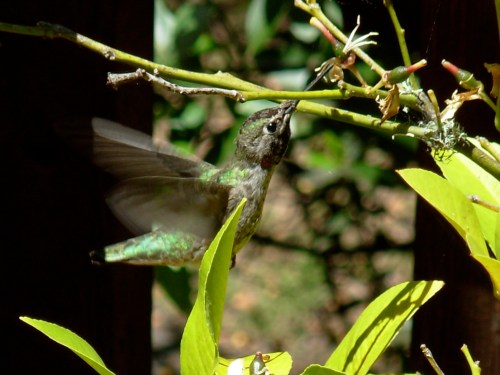
Also seen: a busy female Anna’s hummingbird, enjoying the nectar of a Meyer Lemon tree in Mill Valley. This is a good general hummingbird site.

Happy gathering!

Photos by Susan Sachs Lipman

Go Out and Play: It’s National Get Outdoors Day

As if we needed a reason to get outside on a late-spring Saturday (here’s hoping the weather is nice where you are), along comes National Get Outdoors Day, June 12, a day devoted to healthy outdoor fun. There are lots of specific Get Outdoors Day events planned.

There are, of course, lots of places where you can just get outside and enjoy your day — whether hiking, biking, swimming, walking, picnicking, beachcombing, gardening, exploring, or playing. Discover the Forest and Nature Rocks both offer U.S. maps for finding outdoor adventure spots near you. Nature Worldwide is a great resource about natural places, animals and conservation efforts around the world.

I hope you get outside and have fun!


Photo by Susan Sachs Lipman