Tag Archives: Flowers

Happy Earth Day: Beginner’s Guide to Getting Your Garden Growing

It’s Earth Day, a few weeks into Spring in the Northern hemisphere, and no time like the present to get your garden going — even if (and perhaps especially if) you’re a total gardening novice.

Fear not. Even if you’ve never grown so much as a pansy, the following steps will get you and your garden up and running.

Select your site. 6-8 hours of full sun per day is ideal. If you don’t have that, be sure to buy crops specifically intended to grow in the shade. (These include coneflowers, impatiens, lupine, nasturtiums, snapdragons, beans, beets, broccoli, lettuce, peas, and spinach.) If you don’t have adequate flat space, explore other outdoor space like patios, pass-throughs, or decks. We’ve grown corn, pumpkins, sunflowers, and more on a deck. Don’t forget to think vertically, too — Plant in large boxes and have plants climb up trellises, which many love to do.

Your space needn’t be too large. A 10×10 foot plot can support a few rows of different crops. Often gardeners get overly ambitious and plant more than they can reasonably maintain. If your site is traveled by munching animals, such as deer, you will want to construct some kind of fence around it.

Get comfortable. There are lots of items available to make gardening more comfortable. I suggest knee pads, if you’re going to be doing a lot of kneeling, a sun hat to protect your skin, and old shoes you don’t mind getting dirty or gardening clogs made specifically to get wet and dirty. (A pair of gardening clogs lasts for years. They’re also very comfortable and you can leave them outside.) Most people like gardening gloves and there are a range of them on the market. I find them irresistible to buy at gardening and hardware stores, with their cute patterns, but I almost always end up taking them off and getting my hands really dirty — the better to feel the plants, the dirt, and what I’m doing.

Prepare the soil. Use a pitchfork to loosen the ground, preferably down to about 8 inches. Clear the surface with a heavy-duty rake. Break up dirt clods and pull weeds. (These can be added to a compost, if you’re composting.) If you wish, you can buy packaged soil for a nice even top layer that will have some nutrients in it, especially if you suspect your soil is poor. (Take a sample into your local garden-supply store for an opinion.) Either way, some sort of packaged fertilizer should be added as well. A general mix for new plantings is usually good, but the folks at the garden center may have more specific advice based on your soil and what you’d like to grow, as well as how much organic matter you want to add. Always water thoroughly before adding fertilizer. (And have kids wash hands after handling.)

If possible, plan some paths in your garden. They will make it easy to water, weed, and harvest without stepping on plants. Some people cover the paths with tanbark or other material (available at garden-supply stores) to mark them and to discourage plants from taking root there. Make sure you have a good path for your hose and a water source.

Plant the seeds or seedlings. For most people, this part is especially fun. Follow the packet instructions for seed spacing and conditions. You may want to lay a line of string as a guide, or create a shallow furrow in the dirt with a spade. Some stores carry seed tapes, which you just lay down in a straight row. Tapes are great for tiny hard-to-handle seeds like carrots, which can be difficult, even for adults. Large, easy-to-plant and -grow seeds include nasturtium and pea. If you’re planting bedding plants, be sure to give each lots of room to spread out and grow. Try to anticipate the heights of your plants to get the tallest ones into the back. And don’t forget to grow something that you’d like to see or eat!

Fertilize. If you didn’t add fertilizer to the bed while preparing the soil, add a little bit while planting. There are fertilizers on the market that are designed specifically for new growth. And there are many organic fertilizers available, which is optimal if you’re growing food. Ask the folks at your local garden center to help you choose one for your garden and conditions. Many people fertilize plants again at about six weeks into the growing process.

If you are gardening in containers, get the biggest containers you have space and money for. Check for adequate drainage holes. If you don’t have good drainage, you can add netting or pieces of broken pottery to the bottom of the pot. You may also want to add perlite, which will aerate the soil while helping it retain moisture. Fertilize as you would in a garden plot.

Water your plants or seeds. New transplants and freshly planted seeds like lots of water. The best kind of watering is done gently and deeply, so that the water soaks through to the growing roots of the plants. Once your plants are established, you will probably need to water every other day or so when the weather is sunny. (Plants in containers usually need water more often than plants in the ground.) If a plant droops during the day, or the soil feels dry more than a couple of inches down, it needs water. Try not to water in bright sunshine because the sun can evaporate the water or even cause burned spots on the plants.

Keep up the good work. Continue watering and caring for plants as needed. This can include pulling out obvious weeds and cutting back any growth that has died or become unattractive.

Harvest what you’ve grown. Sometimes I’ve been so proud of my work and/or not sure when to harvest that I’ve let plants go past the point when they’re edible or useful and all the way to seed. Take a chance and cut and enjoy what you’ve done. More will usually grow back!

Have fun entering one of the oldest and most rewarding hobbies around!

Photos by Susan Sachs Lipman

You may also be interested in Earth Day and Every Day: How to Make Gardening Extra Fun for Kids

Tulipmania 2012

Like the 17th-century Dutch who experienced one of the biggest boom-and-bust cycles in history, my family and I find ourselves gripped by Tulipmania each year. We pore over photos of tulips on the Internet and at our local garden center and ultimately choose a few for reasons that vary widely each year — a lovely pale shade here, a bright color there, a curve of shape or a frill of petal.

Whichever types you choose, planting tulips is a terrific family project that brings you a lot of beauty and wonder for relatively little effort. For more information about planting, see Tulips are in the Ground. Here are this year’s tulips:

Salmon Impression

We chose Salmon Impression for its wonderful pastel color, and it didn’t disappoint. This variety yielded beautiful large flowers on strong, tall (20-24″) stems. I especially enjoyed the subtle green coloring on each petal.

Ivory Floradale

Another gorgeous flower (and another Darwin Hybrid type), the Ivory Floradale came in colors ranging from yellow to cream. They also produced a large and interesting flower on a sturdy 20-22″ stem.

DAYDream

A favorite from years past, the Daydream continued to delight again and was a great compliment and accent to the other colors and varieties. Another sturdy flower on a 20-24″ stem, this Darwin Hybrid produced a bright, apricot color and dark centers that were revealed when the petals opened in the sun.

china town

Our last flower, China Town, looked like a lot of fun, with its frilly, multi-colored petals, but, alas, the bulbs went into the ground and failed to grow. Luckily they were in a separate container, so that our bright display bloomed in a happy group.

As always, we treasured our tulips while they were here. Until next year!

Photos by Susan Sachs Lipman

More Tulipmania from Slow Family:

Tulipmania 2010, Part One (Lots of tulip photos)
Tulipmania 2010, Part Two (More tulip photos)
Tulipmania: One Bubble I can Really Get Behind
Tulips are in the Ground

Tulips are in the Ground!

My family and I love tulip-planting time. We have many memories of going out on bright and chilly late November or early December days, digging into the dirt and placing our bulbs into the ground, along with our visions of colorful and elegant tulips coming up in the spring.

The big bulbs (and, of course, the gorgeous flowers) make tulips especially fun and easy for kids to plant and then watch emerge from the ground, sometimes among the first flowers to do so after the winter. Kids usually enjoy learning that the bulbs have most of the nutrients inside to create a flower (but still like a little boost at planting time – we use an organic bulb food.) This makes bulbs a great item to plant in school yards or public spaces because they don’t need a lot of watering or care while they’re growing.

Because we live in Sunset Magazine’s gardening zone 17 (USDA Zone 9), we refrigerate our bulbs for 6 weeks to simulate a Northern winter. And, because we haven’t had much success preserving our tulips from year to year (see the next paragraph for ideas about that), we always have some new tulips to try. Of course that’s a big part of the fun – poring over web sites and practically drooling over the local nursery displays. The chosen bulbs then go into the fridge for their hibernation. And, on an invariably cold, crisp day — in 6″ deep holes (aided by a simple bulb digger) and with a little organic fertilizer (the white stuff you see) — into the ground they go. We used sticks to mark different color bulbs while we were planning our planter boxes.

Because tulip bulbs are generally indicated to bloom early, mid or late spring, you may want to choose bulbs that bloom at about the same time (which we did, because we have a small planting area) or choose bulbs for continuous blooms. Heights are also estimated so that you can plant taller ones in the back of a display.  Tulips tend to look best grouped, rather than in a line.

Want to know more about bulbs and planting? The Blooming Bulb site sells bulbs and offers more detailed tulip planting and storing instructions. The Plant Expert is a fabulous resource about choosing, planting, storing and growing bulbs and all kinds of plants. Another is Doug Green’s Flower Garden Bulbs, which sells bulbs as well. Colorblends (which offers more great planting information), Brent and Becky’s Bulbs and K. VanBourgondien and Sons also sell wonderful selections of bulbs throughout the year by mail order. I also recently found an article about storing bulbs for use the next year, which the writer says is a good idea in any garden where the bulbs will be planted over, not just our warm-winter gardens. I think we will try these new techniques this year!

So, what did we plant?

Come drool with us!

DAYDream

Of our four different tulips, one was brought back from two years ago, the lovely Daydream. A Darwin hybrid, the Daydream is a classically shaped tulips in a soft apricot color, with with a little color variation for interest. The flower height ranges from 20”-24”. I found the stem to be nice and sturdy, and the bulb a pleasing size and perfect color. Some of the flowers tended toward pale yellow tones. Daydreams open in the sun to reveal a black center.

Darwin Hybrids were originally cultivated by crossing single late Darwin and Cottage tulips with early Fosteriana tulips to produce beautiful results.

Salmon Impression

Salmon Impression is another in the sherbet-like color range that I like. A Darwin Hybrid, like the Daydream, we’re told the Salmon Impression is especially sturdy and does well in various climates and conditions, as well as producing large, pretty flowers on strong stems that reach 20-24″.

Ivory Floradale

I think a light or dark accent color is nice among the tulips. This year we went for the light and creamy colored Ivory Floradale. It’s another Darwin Hybrid (I guess we know what we like) and is said to grow to 20-22″ on a strong stem.

china town

We usually try to plant one especially exotic tulip – one with frilly edges, or flames of color shooting through it, or a Viridiflora, a tulip type that offers streaks of stem-like green along its flower. This year’s is the China Town. Writes Bissett Nursery: “Flaring petals of pink, edged in cream streaked with a moss green.  Artistic and unusual in design.  China Town also has especially attractive foliage – dark green leaves with white borders.” This flower is said to grow 14-20″ and is in its own pot in a very visible spot.

Photos: Daydream: Susan Sachs Lipman; Salmon Impression: Botanus; Ivory Floradale: Van Bourgondien Nursery; China Town: Bissett Nursery. All others: S. Lipman

More Tulipmania from Slow Family:

Tulipmania 2010, Part One (Lots of tulip photos)
Tulipmania 2010, Part Two (More tulip photos)
Tulipmania: One Bubble I can Really Get Behind


Photo Friday: Market Tulips

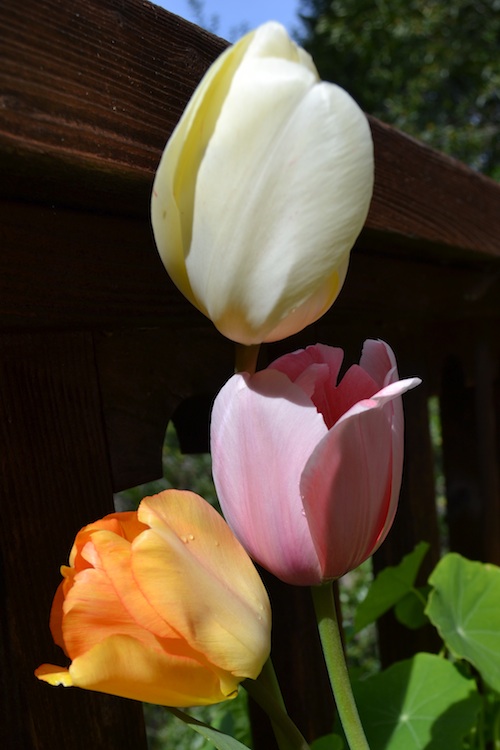
Blame it on the gray day outside — today’s Photo Friday called for an infusion, and a profusion, of bright tulips. These candy-colored specimens were spotted last week at my local market. What an eye-popping delight!

I hope you’re enjoying your local season and its flowers!

Have you seen and photographed something unusual, whimsical, beautiful, or otherwise interesting in your travels? Has anything surprised you or caused you to pause? Or have you simply experienced a small, lovely moment that you wanted to capture? If so, I hope you’ll share with us by leaving a comment with a link to your photo. I look forward to seeing it!

Photo by Susan Sachs Lipman

You might also like:

Photo Friday: Serene Spring
Photo Friday: World’s Favorite Tulip
First of Spring: Larkspur, CA

Happy Earth Day! Beginners Guide to Getting Your Garden Growing

It’s Earth Day, a few weeks into Spring in the Northern hemisphere, and no time like the present to get your garden going — even if (and perhaps especially if) you’re a total gardening novice.

Fear not. Even if you’ve never grown so much as a pansy, the following steps will get you and your garden up and running.

Select your site. Ideally your plot will get 6-8 hours of full sun per day. If such a site is not available, be sure to buy crops specifically intended to grow in the shade. If you don’t have adequate flat space, explore other outdoor space like patios, pass-throughs, or decks. You can still get a lot of usable space by planting in large boxes and having plants climb up trellises, which many love to do. Your space needn’t be too large. A 10×10 foot plot can support a few rows of different crops. Often gardeners get overly ambitious and plant more than they can reasonably maintain. If your site is traveled by munching animals, such as deer, you will want to construct some kind of fence around it.

Prepare the soil. Use a pitchfork to loosen the ground, preferably down to about 8 inches. Clear the surface with a heavy-duty rake. Break up dirt clods and pull weeds. These can be added to a compost, if you’ve chosen to compost. If you wish, you can buy packaged soil for a nice even top layer that will have some nutrients in it, especially if you suspect your soil is poor. (You can always take a sample into your local garden-supply store for an opinion.) Either way, some sort of packaged fertilizer should be added as well. A general mix for new plantings is usually good, but the folks at the garden center may have more specific advice based on your soil and what you’d like to grow, as well as how much organic matter you want to add. Always water thoroughly before adding fertilizer. (And have kids wash hands after handling.)

If possible, plan some paths in your garden. They will make it easy to water, weed, and harvest without stepping on plants. Some people cover the paths with tanbark or other material (available at garden-supply stores) to mark them and to discourage plants from taking root there. Make sure you have a good path for your hose and a water source.

Plant the seeds or seedlings. For most people, this part is especially fun. Follow the packet instructions for seed spacing and conditions. You may want to lay a line of string as a guide, or create a furrow. Some stores carry seed tapes, which you just lay down in a straight row. Tapes are great for tiny hard-to-handle seeds like carrots, which can be difficult, even for adults. Large, easy-to-plant and -grow seeds include nasturtium and pea. If you’re planting bedding plants, be sure to give each lots of room to spread out and grow. Try to anticipate the heights of your plants to get the tallest ones into the back. And don’t forget to grow something that you’d like to see or eat!

Fertilize. If you didn’t add fertilizer to the bed while preparing the soil, you’ll want to add a little bit while planting. There are fertilizers on the market that are designed specifically for new growth. Your local garden center is the best bet to point you toward a good fertilizer for your garden and conditions. Many people fertilize plants again at about six weeks into the growing process.

If you are gardening in containers, get the biggest containers you have space and money for. Check for adequate drainage holes. If you don’t have good drainage, you can add netting or pieces of broken pottery to the bottom of the pot. You may also want to add perlite, which will aerate the soil while helping it retain moisture. Fertilize as you would in a garden plot.

Water your plants or seeds. New transplants and freshly planted seeds like lots of water. The best kind of watering is done gently and deeply, so that the water soaks through to the growing roots of the plants. Once your plants are established, you will probably need to water every other day or so when the weather is sunny. (Plants in containers usually need water more often than plants in the ground.) If a plant droops during the day, or the soil feels dry more than a couple of inches down, it needs water. It’s best not to water in bright sunshine because the sun can evaporate the water or even cause burned spots on the plants.

Keep up the good work. Continue watering and caring for plants as needed. This can include pulling out obvious weeds and cutting back any growth that has died or become unattractive.

Be sure to harvest what you’ve grown. Sometimes I’ve been so proud of my work and/or not sure when to harvest that I’ve let plants go past the point when they’re edible or useful and all the way to seed. Take a chance and cut and enjoy what you’ve done. More will usually grow back!

Get comfortable. There are lots of items available to make gardening more comfortable. I suggest knee pads, if you’re going to be doing a lot of kneeling, a sun hat to protect your skin, and old shoes you don’t mind getting dirty or gardening clogs made specifically to get wet and dirty. (A pair of gardening clogs lasts for years. They’re also very comfortable and you can leave them outside.) Most people like gardening gloves and there are a range of them on the market. I find them irresistible to buy at gardening and hardware stores, with their cute patterns, but I almost always end up taking them off and getting my hands really dirty — the better to feel the plants, the dirt, and what I’m doing.

Have fun entering one of the oldest and most rewarding hobbies around!

Photos by Susan Sachs Lipman

Photo Friday: World’s Favorite Tulip

As many readers know, I am an inveterate, unabashed, unapologetic lover of tulips! The most recent burst of rain and wind pretty much took the last petals of our tulips, but they were glorious again this year. A full report is coming. For now, there are these, Darwin Hybrids that really are called World’s Favorite.  Bright, large, dramatically colored — they did not disappoint. Neither did the great blue sky I found them under one recent day.

I hope you’re enjoying Spring in its full flower!

Have you seen and photographed something unusual, whimsical, beautiful, or otherwise interesting in your travels? Has anything surprised you or caused you to pause? Or have you simply experienced a small, lovely moment that you wanted to capture? If so, I hope you’ll share with us by leaving a comment with a link to your photo. I look forward to seeing it!

Photo by Susan Sachs Lipman

You might also like:

Photo Friday: Signs of Spring
Photo Friday: Gather ye Rosebuds
First of Spring: Larkspur, CA

Photo Friday: Signs of Spring

Wherever you look in Amsterdam in late winter, there is something .. well, cute. Picturesque. A harbinger of the Spring season to come. The first tulips appear on corners and in big flower markets, their heads still tightly closed. At the same time tulip bulbs are available for sale for those who still wish to get them into the ground.

And of course there are the bikes — flower- and basket- and sometimes person-bedecked. Whizzing by and parked, sometimes two and three deep, in all weather, on the bridges that rise gently over the lovely canals.

Have you seen and photographed something unusual, whimsical, beautiful, or otherwise interesting in your travels? Has anything surprised you or caused you to pause? Or have you simply experienced a small, lovely moment that you wanted to capture? If so, I hope you’ll share with us by leaving a comment with a link to your photo. I look forward to seeing it!

Photo by Susan Sachs Lipman

You might also like:

Photo Friday: De Kaaskamer Cheese Shop
Photo Friday: Carnival in Venice
Tulipmania: Parts One and Two
Daffodils: Bunches of Spring Sunshine

Photo Friday: Gather ye Rosebuds

There are those who find Valentine’s Day trite — a Hallmark holiday, at best — and scoff at roses, chocolates, teddy bears, balloons, and other designations of love. Not me! In addition to celebrating love every day I can, I admit to being a complete sucker for Valentines signs and symbols — for sweet doily-bordered hearts, home-made meals, romantic gifts, and bunches of brightly colored flowers that appear in profusion in the dead of winter. I like seeing them all lined up at the market like these, just waiting for someone (even if at the last minute) to decide to scoop some up just because it’s the best and most extravagant way at the moment to proclaim their feelings.

Have you seen and photographed something unusual, whimsical, beautiful, or otherwise interesting in your travels? Has anything surprised you or caused you to pause? Or have you simply experienced a small, lovely moment that you wanted to capture? If so, I hope you’ll share with us by leaving a comment with a link to your photo. I look forward to seeing it!

Photo by Susan Sachs Lipman

You might also like:

How to Make: Fun and Easy Homemade Valentines
Photo Friday: Between Seasons
Photo Friday: San Francisco Storefront

Photo Friday: Between Seasons

Last weekend, where I live, the temperature seemed to boost about 40 degrees. Sun and warm winds suddenly replaced the frigid air. Overnight, it seemed, fruit trees burst into blossom — nothing subtle or slow — and I could smell wild onions and grasses and the sorts of shoots that signal spring. One front yard on my street, however, is having trouble letting go of the last leaves of fall even as they’re being eclipsed by a splashy early spring show.

Have you seen and photographed something unusual, whimsical, beautiful, or otherwise interesting in your travels? Has anything surprised you or caused you to pause? Or have you simply experienced a small, lovely moment that you wanted to capture? If so, I hope you’ll share with us by leaving a comment with a link to your photo. I look forward to seeing it!

Photo by Susan Sachs Lipman

You may also like:
Photo Friday: San Francisco Storefront

How to Save Nasturtium and Other Seeds

I love nasturtiums and this summer I had a real cascade of them tumbling over the deck boxes in their bright colors and peppery scents. I went to weed them the other day and noticed that many had gone to seed and still many others had dropped their seeds on the deck. I gathered the seeds excitedly, figuring that since they were intact and recognizable as the nasturtium seeds I’d planted before, I should be able to save these for planting in the future.

I since found a couple of wonderful resources about seed saving.

Mr. Brown Thumb has a lot of great information about collecting nasturtium seeds, complete with a video. He says that larger seeds are best, and that it doesn’t matter if the seeds are brown or green. This is good news because I found plenty of both.

About.com has a lot of great information about seed saving in general, including which other seeds are good candidates for saving:

Methods and Timing for Saving Seeds

Always choose the best quality plants, flowers, fruits and vegetables from which to save seeds. Look for disease resistance, vigor, great flavor and productivity. Next year’s plants will only be as good as this year’s seed. Harvest seeds either:

  • When the seed pods have dried on the plant (flowers, beans, broccoli, lettuce…)Keep an eye on the pods as they start to brown. Most seed pods will open and disperse on their own. You can catch seed by placing small bags over the seed heads when they look ready to pop or by pulling the plant just before completely dry and storing upside down in a paper bag.

Storing Saved Seed

  • Make sure the seed is completely dry, or it will rot or mold in storage
  • Remove as much of the chaff as possible
  • Store in a paper envelope, labeled with the variety and year
  • Place the envelopes into an air tight container, such as a canning jar
  • Store in a cool, dark, dry place
  • Stored seed is best used the following year

What Seeds Can Be Saved?

Open Pollinated or heirloom, self-pollinated plants are the only varieties that will grow true from seed, meaning the seedlings will be exactly like the parents. These are the seeds worth saving.

Self-pollinated plants are the easiest to save and include: Beans, Chicory, Endive, Lettuce, Peas, Tomatoes. You can also save many heirloom flower seeds such as: cleome, foxgloves, hollyhock, nasturtium, sweet pea, and zinnia.

I dried my seeds on this old bulb storage crate from the Netherlands. It’s come in handy for all kinds of drying projects.

I stored my seeds according to the above guidelines. I’ll plant them next year and will let you know how they do.

Photos by Susan Sachs Lipman

Related Posts Plugin for WordPress, Blogger...