Last updated by at .

Monthly Archives: June 2013

Enjoy June’s Full Supermoon

Look up in the sky! It’s Supermoon! On Saturday, June 22 and Sunday, June 23, the moon will appear especially large and bright, due to its closer-than-usual relation to Earth. This supermoon, or perigee moon, will be the largest-appearing moon of 2013.

The supermoon will rise from the east around sunset, and then will appear huge and low on the horizon before rising into the sky for the night. Because the moon will be at its fullest Sunday at 7:30 am EDT, both Saturday and Sunday should offer ideal viewing opportunities for those with clear skies.

Read more science behind the supermoon.

Read tips for photographing the supermoon.

The Full Moon

Of course a supermoon is by definition full. People in many cultures throughout history have named the year’s full moons based on the activities that happened during them. The Farmers Almanac calls the June full moon the Strawberry Moon because, for the Algonquin Native Americans, June was synonymous with strawberries. The Cherokee called the June full moon the Green Corn Moon. The Choctaw referred to it as the Windy Moon. Celtic people referred to the June full moon as the Moon of Horses. Throughout much of more modern Europe, the June full moon was known as the Rose Moon, for that flower’s peak.

I’ve long been quite entranced with the full moon names and their variations. Of course, they reflect both the need to mark passing time and the way that time was experienced by people who were living close to the land. Lunar time-keeping pre-dated our modern calendars (and some calendars, like the Jewish and Chinese calendars, are still lunar-based.) The Farmer’s Almanac has a good list of Native American full moon names and how each came to be.

Other, even older, cultures have had moon naming traditions, too. This site lists full moon names from Chinese, Celtic, Pacific Island, Native American, Pagan, and other cultures.

Full Moon Gardening

Lots of people garden using the phases of the moon. The good news is that there isn’t one best time to plant — Each aspect of planting has an associated moon phase, based on how much moisture is pulled up through the soil by the monthly pull of the moon (much the way the moon influences the tides.)

The time just after the full moon is an especially good time for planting root crops, as the gravitational pull is high (adding more moisture to the soil) and the moonlight is decreasing, contributing energy to the roots. For this reason, the waning moon is also a good time to plant bulbs and transplants.

The Farmer’s Almanac offers a wonderful moon phase calendar for the U.S. that allows you to plug in your location and get the exact time of your local full moon.

Whether planting or watching, enjoy June’s full supermoon!

Graphics and Photos: Optics Central, Public Domain, NASA, Susan Sachs Lipman

Join the Great American Backyard Campout June 22

The Great American Backyard Campout is Saturday, June 22. According to sponsors National Wildlife Federation, people register to camp outside June 22, or a night of their choice. You can register at the NWF site, which provides a Campsite Finder full of opportunities to join an existing camping team. Or you can join the Campout in your own backyard, balcony, or local campground. National Wildlife Federation hopes that the Campout will inspire more people to get outdoors and experience the ease and fun of enjoying a beautiful outdoor place and sleeping under the stars.

That’s what happened with me last year, when I was fortunate to join a Campout group at Lake Berryessa in Northern California. We fished and floated in the lake during the day, and sang songs, made s’mores and watched the impressive canopy of stars at night. Many people were camping for the first time with their families. Everyone had a blast.

Me and my camping buds:

You may know that we sometimes pitch a tent on our deck or in a treehouse. Kari of Active Kids Club shares her tale of Balcony Camping in an urban backyard.

Debi at Go Explore Nature offers tons of outdoor activities to add to the fun while camping, like a Flashlight Walk or a Bug Hunt.

Looking for more fun things to do outdoors? Try these Seven Things to Do After Dark from National Wildlife Federation.

Here are more Camping Tips, games, songs and recipes from NWF.

Of course, no camping outing is complete without s’mores, the gooey outdoor treat that first appeared in the 1927 Girl Scout Handbook, Tramping and Trailing with the Girl Scouts, which coincided with the beginning of mass-produced graham crackers and chocolate bars.

See my S’more Recipes.

Enjoy your time outdoors!

Photos: Susan Sachs Lipman


Happy Summer! Easy Summer Solstice Cupcakes

Updated for 2014Summer Solstice, the longest day of the year and the beginning of the summer season, is upon us June 21 this year, at 05:04 10:51 Universal Time, or 1:04 3:51 am on the U.S.’ east coast, 10:04 pm, June 20, 6:51 am on the west. Throughout the Northern Hemisphere, it can be marked by Midsummer festivals, especially in Scandinavia, where people celebrate with maypoles that honor nature’s bounty and bonfires that recall the heat and warmth of the sun. Still other cultures have solstice rituals that honor the sun, the feminine and the masculine.

Here in the San Francisco Bay Area, my family often attends a summer solstice celebration at Muir Beach, hosted by the Muir Woods National Monument park rangers. We enjoy a bonfire, nature storytelling and campfire songs, and a ritual walk around the fire, holding stalks of sweet flowers and herbs, and then throwing them into the fire, to greet the new season and also let go of anything that no longer serves us.

View more photos of summer solstice at Muir Beach.

An easy way to celebrate Summer Solstice, whether your gathering is a large one or a cozy one, is to make Summer Solstice Cupcakes. This recipe comes from the terrific book, Circle Round:

Just as Winter Solstice gives birth to the light, Summer Solstice, with its day that never seems to end, holds the seeds of darkness. We discover darkness in the bits of chocolate concealed inside this sunny cupcake.

1/2 C butter (one stick) softened in the summer sun
1 C sugar
2 eggs
1 t. vanilla extract
2 C flour, sifted first and then measured
pinch of salt
2 t. baking powder
1 C milk
1 C chocolate chips

Cream together the butter and sugar until light and fluffy. Beat in the eggs one at a time. Add vanilla. Mix together the flour, salt, and baking powder. Add half of the dry ingredients to the wet mixture and stir in. Follow with 1/2 cup milk, then the other half of the flour mixture and the rest of the milk. Stir in the chocolate chips.

Use paper liners, or grease and flour cupcake tins. Bake for 25 minutes in a preheated 375′ oven.

Makes 20 to 24 cupcakes.

Because of the sweetness of the cake and chips, these don’t need frosting, but you can certainly add it, in a solid color or a cheery sun or flower design.

This is a great explanation of how Summer Solstice works. Happy Winter Solstice to those in the Southern Hemisphere, who are marking the lengthening days. Perhaps chocolate cupcakes with white chocolate chips are in order?

Happy Solstice to all!

Photos: Susan Sachs Lipman

It’s National Pollinator Week: Have Fun Attracting and Helping Bees, Butterflies and Birds

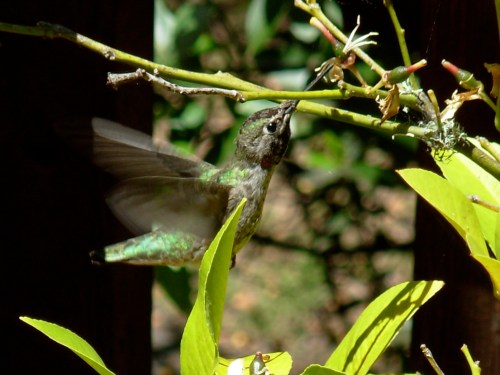
June 17-23 is National Pollinator Week. It’s a week to celebrate and educate about pollinating animals, such as bees, birds, butterflies, bats, beetles and others, which are extremely vital to our ecosystem. Pollinators support much of our wildlife, lands and watersheds. Nearly 80% 0f the 1,400 crop plants grown around the world that produce all of our food and plant-based industrial products require pollination by animals.

There are so many simple ways to welcome pollinators into our home gardens and other outdoor spaces. In addition to helping the earth’s ecosystem and food supply, you’ll also experience the fascination and wonder that comes from observing the animals you attract. Here are a few ways to get more involved:

Find or add an event through Pollinator Partnership, a wonderful resource about pollinators year-round.

Garden for wildlife with tons of tips and guides from the National Wildlife Federation, which offers a Certified Backyard Habitat Program.

Check out NWF gardeners’ favorite plants for attracting pollinators.

Find more information about gardening for wildlife from the U.S. Fish and Wildlife Service.

Join the Great Sunflower Project and many other citizen science projects that allow you to help researchers right from your own backyard or a local park.

Spring at the Bird Cafe and bird feeder activity.

Make a quick and easy bird feeder to attract and observe birds.

Enjoy beautiful nature during Pollinator Week and throughout the year!

Photos: Susan Sachs Lipman, Public Domain

Tidepooling with Kids: The Best Ways and Places to Explore Undersea Creatures

The undersea world is always fun to explore at low tide, when creatures like barnacles, crabs, periwinkles, and sea stars, who are normally underwater, become revealed. This summer, those of us on the North American coasts are in store for a great show, as there will be some very low tides, or minus tides, at times of the day and year when we can get out and enjoy them. My home, San Francisco Bay, will enjoy minus tides this June 9-13 and June 23-27. Check one of the tide tables below for tides in your area.

How do Tides Work?

Tides are influenced by the moon, whose gravity pulls at the oceans each day as the Earth completes its daily spin. That pull creates a high tide at the portion of the Earth where it occurs. Most places experience two high tides each day. The second one occurs when the moon’s gravity pulls on the spot exactly opposite it on the Earth. (The second high tide is usually not as high as the first high tide.) Low tides occur when the moon is first rising in the east, or setting in the west, and the strong pull is happening elsewhere. Full or new moons usually create higher high tides and lower low tides than moons in other phases.

tidepool2

Reading a Tide Table

Tides are relatively predictable, but not entirely, as they can be altered by factors like temperature, air pressure, storms, and wind. A tide table is like a forecast, as opposed to a rigid schedule. That said, tide tables are usually fairly accurate. Most tide tables read in military time (a 24-hour clock), rather than using a.m. and p.m. Tides are measured in feet, so a 2.0 tide means that the water is two feet high.

The intertidal zone, which is what you’ll be exploring, is the area that is revealed during a low tide and covered during a high tide. You can begin to see some creatures in this area when the tide is as low as 1.5, but your best bet for seeing a show is to visit when the tide is listed as a “minus tide”, which is an especially low tide. Try to time your visit to arrive before the time listed, so you catch the tide going out. Generally it goes out (becomes lower) for about two hours, and comes back in for an hour and a half, so that’s the window of time for the visit. You need to be aware of the time and the tides, especially if the beach you’re exploring is one that can become cut off from access during high tides, or is known for tides that rise quickly. (The best beaches for exploring intertidal life with children have easy access, even during high tides, and are not known for large waves or drastic changes. That said, visitors still have to be aware of the tides and the time.)

These are some fairly accessible tide tables:

U.S. East and West Coast tide table, search by state

San Francisco Bay Area tide table

There are others online, and others that can be purchased at bookstores and marine-supply stores in calendar form.

Be sure to follow any links to the adjusted times for different spots up and down the coasts, as the tide times change based on exactly where the tide hits.

tidepool

Who Lives in the Intertidal Zone?

When the tide retreats, sea creatures can be seen clinging to, or underneath, rocks. These animals, as well as intertidal plants, are especially adaptable to their changing conditions. They are often also colorful and unusual. The animals you will likely see include limpets, which stick to rocks high in the intertidal zone, and their relatives, the chitons. Children may identify periwinkles, which have a snail-shaped shell, and tough barnacles, which cling to rocks and other surfaces. You may see sculpins, which are tiny fish, moving in the extremely shallow pools, or prickly sea urchins, or everyone’s favorite, the many kinds of starfish (sea stars). There will likely be many types of crawling crab. And you’ll probably also see anemones, which open and close around food, or a gently placed finger, and which squirt a bit when touched.

The best way to identify these various creatures is to pick up a field guide to local sea life at a bookstore or library. Some places also sell easy-to-reference cards that can be worn around the neck, saving you from fumbling with a book while out along the shore.

tidepool3

12 GREAT Tidepool Spots

Some of the largest of these feature more than one great tidepooling beach.

Cabrillo National Monument, San Diego, CA

Leo Carillo State Park, Malibu, CA

Morro Bay, CA

Pillar Point Harbor, Half Moon Bay, CA

Fitzgerald Marine Reserve, Moss Beach, CA

Duxbury Reef, Bolinas, CA

Yaquina Head Outstanding Natural Area, Newport, OR

Olympic National Park, Olympic Peninsula, WA

Kapoho Tide Pools, Big Island, HI

Bahia Honda State Park, Bahia Honda, FL

Hunting Island State Park, Beaufort, SC

Acadia National Park, Bar Harbor, ME

tidepoolanna

Tips for Making the Trip Enjoyable and Preserving the Habitat

Tidepools are very sensitive environments that are easily damaged or even destroyed, so it’s important for visitors to be aware of the fact that they will be walking among, and probably on, living creatures. Remember that you are a guest in the animals’ habitat. It will also help to follow these tips for respectful visits:

Look before you walk to try to avoid stepping on barnacles, mussels, and other creatures. Walk carefully for your own safety and to protect all the tidepool life.

Leave animals where they are. Don’t pry them off of rocks. Removing them from their habitat could be very dangerous to them. Many don’t survive once removed, even if people think they are placing them back in their spots.

Also leave shells, rocks, plants, and other marine life in its place, as much of it serves as homes to the sea life.

Do not bring household pets to the tidepool.

Do not disturb other animals, like seals or birds, that may also be present.

Other tips to help visitors stay safe and enjoy the experience include:

Try to find a good guide book ahead of time so you can acquaint yourself with some of the marine life you may be encountering, and possibly bring the book for use at the tidepool.

Be sure you’ve planned your trip to arrive before low tide and leave before the next high tide.

Stay aware of the tides. Keep an eye on the waves as the high tide is coming in.

Tidepools are slippery, so wear shoes with good traction that can get wet.

Dress in clothes that can get wet and keep you warm. It could be windy or chilly.

Take the time to really observe the tidepool life. Lots of animals are not immediately apparent to visitors.

Something about the act of tidepooling in the early morning hours invariably leaves our family hungry. Plan to stop for breakfast or lunch on the way home and talk about all the marine life you saw.

For more tidepool photos see:

Our Trip to the Tidepools

tidepool4

Photos by Susan Sachs Lipman

This activity was adapted from Fed Up with Frenzy: Slow Parenting in a Fast-Moving World, which contains 300+ fun family activities.

Enter the CLIF Kid Backyard Game of the Year Contest

If you are age 6-12 and you have an original idea for a backyard game, you could win a $10,ooo scholarship, or enter a game as a group and win a $15,000 donation to the non-profit of your choice. Now in its third year, the CLIF Kid Backyard Game of the Year Contest fosters creativity and outdoor play by encouraging innovative games that don’t require any special equipment, but rather sports and other items one would typically have around the house.

One of last year’s winning games, North Pole South Pole (pictured above), encourages players to be “persistent penguins” who gather fish from a fishing hole before depositing them at their North or South Pole. The equipment? Hula hoops, pillowcases and water balloons. Download instructions for North Pole South Pole and other winning games.

The entry deadline is June 17. The finalists will receive a trip to San Diego for the July 27 Backyard Game playoffs. Download a complete set of rules.

As a bonus, the 2013 judges include Stacy Tornio and Ken Keffer, co-authors of the fantastic Kids Outdoor Adventure Book, which I reviewed on this blog, and which also encourages outdoor play and discovery throughout the year.

So, what are you waiting for? Put your thinking cap on and get ready to innovate and play.

Photos: CLIF Kid

Other Slow Family posts you might like:

Kids Outdoor Adventure Book Makes You Want to Go Out and Play
NFL Play 60 Invention Contest (and jump rope games)
American Academy of Pediatrics Advocates Recess for Kids (with playground games)
8 Fun Things to Do While it’s Still Summer

June is the New December: 10 Ways to Calm End-of-School-Year Frenzy

As a parent, I’ve always found the end of the school year to be a mixed bag. It can be an exciting time to look forward to summer plans and the relaxation, fun and family time they portend. It can offer meaningful rituals and warm celebrations with family and friends. It can also be ridiculously busy and packed with obligations and graduations (from pre-school on up), not to mention parties and ceremonies for every classroom, team and group.

This time of year definitely got easier for me with the passing years. There seem to be less scheduled events now that my daughter is a little older, and the events themselves seem to be more relaxed — I always thought all-day picnics at rented pools, with transportation and activities and awards and lots of necessary parent-volunteer help were too much for smaller kids anyway. Likewise, endless award ceremonies and graduations for tiny children who would rather be playing. And, for that matter, a too-busy calendar.

One special year (over objections from some parents – is that who these parties are for?) the kids in my daughter’s class all walked to a teacher’s house because they had wanted to play with her dogs. They had picnic lunches and played games in a park and walked back to school for the end of the day. It was probably one of the simplest, most memorable year-end parties of all, because it came from the hearts of the teacher and the kids, and not from another adult’s idea of what a year-end party should be.

So, how can you keep year-end frenzy at bay, for yourself, your family, and possibly a class or group?

Check in with yourself and others. Ask yourself and your family members if you’d prefer some down-time to attending one more activity, or taking part in just one segment of a multi-part event.

Give yourself permission to sit some events out. You probably know if an event is too much for your child or your family. Try to honor everyone’s limits. There will be ample opportunity for more celebrations in the future. Also, look at each event practically. If younger siblings can attend, if everyone is fed — these things might make an event more palatable, workable and fun.

As a parent, You don’t have to volunteer for every task. It’s nice to do your part, and volunteering can be a lot of fun. It can also allow you to make the most of each activity and not feel as if they are flying by. However, do listen to your gut if it tells you you’re taking on too much or the wrong thing. Sometimes well-meaning parents create very complicated activities and projects that ultimately don’t have a lot of meaning for the kids (or for you). I wish I would have extricated myself from a couple of those.

Create some unstructured family time. It will take some extra effort when things are especially hectic, but that’s just when you need some unstructured time the most. As counter-intuitive as this may sound, if you need to write it in your calendar, do so. Take an afternoon to lie on the grass and watch the clouds, or take a family walk in your neighborhood. Pull a chair outside at twilight and watch the first stars come out. Eat a simple dinner as a family. Let yourself get so bored that time actually seems to slow down, or keep a free day open to do whatever you really feel like that morning.

Spend time in nature. Nature truly does have a way of relaxing and rejuvenating both body and spirit. It can be just the antidote to a hectic schedule. Children and adults can experience awe in nature in a deep, profound way. It’s also often a great place to run around and let off steam, or, conversely, to be contemplative and quiet in the midst of a busy season. Nature also provides a wonderful perspective and a place of fresh wonder that has little to do with the busy-ness of modern life.

Let children be children. Consider which events have the most meaning for your children and prioritize those. Try not to feel pressured to participate in an event or a schedule that doesn’t feel right for your family. If you are in any position to help plan the activities, try to keep the playful, and the age-appropriate meaningfulness, in mind. Perhaps others will follow your lead.

Discuss your child’s feelings. Despite the celebratory nature of the events, some children will feel a tremendous amount of confusion or dismay about the passage of time or the possible change that it brings. Others may be overwhelmed by any celebration or attention. Try to allow some time and space for children to express themselves and their needs.

Get enough sleep. Force yourself and your children to go to bed at a reasonable hour (possibly even unwinding a bit before bed). Save some tasks for another day — they’ll still be there. Getting enough rest, eating well, and treating yourself well are fundamental tools in warding off the stress of a busy schedule.

Let go of perfection. The end of the year can mean houseguests or the hosting of meals. So, to our busy schedules, we add the task of making our homes appear perfect. Clean what you reasonably can and let the rest go. If people have come to celebrate you and yours, that includes your home in its glorious imperfection. Besides, most people don’t look at our houses with the same critical eye we do.

Charge up the camera batteries, bring some Kleenex, and Enjoy the rituals. If you are attending a full-fledged graduation or similar rite of passage or achievement, delight in the moment and the celebrant and enjoy the blessings of family and well-wishers.

And, if all this still doesn’t help, remember that things will be relatively quiet soon.


These tips were adapted from Fed Up with Frenzy: Slow Parenting in a Fast-Moving World, which contains 300+ fun family activities and slowing techniques.

Photos by Susan Sachs Lipman


Related Posts Plugin for WordPress, Blogger...