Monthly Archives: January 2013

Inspire a Lifelong Love of Reading with the Ease of Netflix

Our whole family adores books. Especially children’s books. And with that comes delightful, but groaning, shelves (and piles and boxes and an attic full) of books.

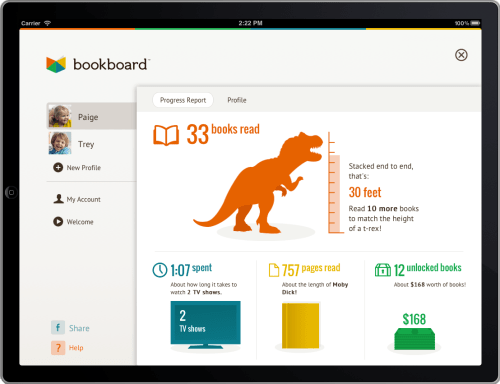
What if there were a way to cut down on the volume but still enjoy current and classic children’s books that were available as easily as streamed movies, that challenged our children to grow and discover new titles, and that made books as accessible, interactive and fun to use as the latest app? There is. Bookboard brings you all of the above and more in a well-designed new system that lets kids read books and participate in fun online progress metrics that they unlock through their reading achievements. Book titles are based on personalized suggestions and are immediately available for download, the same way Netflix movies are available for screening.

Parents can also follow their children’s progress and help them find new titles. Bookboard encourages many of the traits that help create lifelong readers, even among those who are reluctant. These include variety and choice of materials, social interaction, and both new and familiar experiences.

On a test-run, we found Bookboard’s books and graphics attractive and its interface appealing and easy to use.

As a book-loving mom in a family of lifelong readers (hence the groaning bookshelves), I’m thrilled that there are new opportunities for new generations to enjoy reading and books in a way that is comfortable, natural and appealing. Neither Michael nor I would give back any of the hours that we spent with Anna, reading her multiple bedtime stories night after night. The time we spent reading together helped create an intense bond that lasts to this day, a bond due both to our physical closeness and to the wonderful books we all discovered together and still talk about.

Bookboard is free for a limited time. A subscription service is planned.

Sign up and read a book from Bookboard between now and February 11, 2013,  and you’ll be entered in a giveaway for an iPad Mini. When you sign up, you’ll have access to Bookboard (and their current slate of titles) free of charge for one month. See Bookboard for rules and details.

This post is sponsored by Bookboard. The opinions expressed are my own.

Images: Paper Tigers, Bookboard

Have Some Shadowy Fun on Groundhog Day

Just in! Punxsutawney Phil did not see his shadow. He predicted an early spring on Groundhog Day.

Groundhog Day, February 2, has basically everything going for it that I love in a holiday — It marks a point in a season; it’s full of folklore and wisdom, superstition, ceremony, civic charm, science, mystery, agrarian history, and weather — and it was featured in perhaps my all-time favorite movie of the same name, which itself is a study in acceptance and inner calm while being outright hilarious in nearly every frame.

Altogether now: It’s Groundhog Day!

In an early morning ceremony, groundhog Punxsutawney Phil will rise from his heated burrow at Gobbler’s Knob, PA, as he has for 125 years, and signal to his handlers whether or not he sees his shadow. No shadow means an early end to winter. And if the groundhog does see his shadow? Six more long weeks of the season. Over the years that the ceremony has taken place, Phil has seen his shadow 98 times and not seen it only 17. (Records don’t exist for every year.) In 2008, the crowd heartily booed the prospect of “six more weeks of winter”.

Some have stated that Phil’s “handlers” make the prediction for him. What do we think of that?

History and science of Groundhog Day

According to this excellent Groundhog Day site, German settlers arrived in the 1700s in the area of Pennsylvania, northeast of Pittsburgh, which had been previously settled by the Delaware Native Americans. The Germans celebrated Candlemas Day, originally a Medieval Catholic holiday to mark the mid-point between the Winter Solstice and the Spring Equinox in the Northern Hemisphere. The holiday also has roots in Celtic-Gaelic and Pagan cultures, where it is celebrated as St. Brigid’s Day and Imbolc, and is a time of festivals, feasting, parades, and weather prediction, as well as candles and even bonfires to mark the sun’s return.

According to Wikipedia, the origin of the word “Imbolc” is “in the belly”, and among agrarian people, Imbolc was associated with the onset of lactation of ewes, which would soon give birth to lambs in the spring.

The German settlers of Pennsylvania put candles in their windows and believed that if the weather was fair on Candlemas Day, then the second half of winter would be stormy and cold. While this has always seemed counter-intuitive to me, this site explains the science of Groundhog Day and that cloudy weather is actually more mild than clear and cold. It makes sense, then, that the shadow would portend six more weeks of winter. (A lifelong mystery is solved.)

The English and Scottish had wonderful sayings to mark this occasion:

The serpent will come from the hole
On the brown Day of Bride,
Though there should be three feet of snow
On the flat surface of the ground.

– Scottish saying
(Note the serpent instead of the groundhog.)

If Candlemas be fair and bright,
Winter has another flight.
If Candlemas brings clouds and rain,
Winter will not come again.

– English saying

Punxsutawney’s first Groundhog Day celebration was in 1886, and though other towns, particularly in the eastern U.S., have Groundhog Day ceremonies — Staten Island Chuck, anyone? — none is nearly as famous as Punxsutawney’s. Some of this may lie with the groundhog’s official name, “Punxsutawney Phil, Seer of Seers, Sage of Sages, Prognosticator of Prognosticators, and Weather Prophet Extraordinary”. Still more popularity, and tourists, have come as a result of the movie Groundhog Day. The first official Groundhog Day prediction in Punxsutawney? No shadow – early Spring.

This site has more information about the groundhog itself and about the filming of the movie.

If you are a Groundhog Day movie obsessive like me, you will enjoy this site that breaks down exactly how long Bill Murray’s character, Phil the Weatherman, experiences Groundhog Day in Gobbler’s Knob.

Groundhog activities and crafts

It’s fun to play with shadows, in honor of Punxsutawney Phil and his. Try making hand shadow puppets, something people have been doing since 2,000 years ago in China, where it was performed by oil-lamp light. Have someone project a flashlight onto a wall or other surface. Hold your hands between the light and the wall in various shapes to create shadow puppets. Here are some classic ones to try:

Rabbit—Make a fist with one hand. Place the other palm over it and make a peace sign (for ears) with two fingers.

Hawk—Link your thumbs together, with your hands facing away from you. Stretch out your fingers and hands and flutter them like wings.

Spider—With palms facing up, cross your hands at the wrist. Press your thumbs together to form the spider’s head. Wiggle your fingers in a climbing motion.

Wolf or dog—Place your palms together, fingers facing outward. Put your thumbs up to form ears. Let your pinkie drop to form a mouth. Bend your index fingers to create a forehead.

Camel—Lift one arm. Hold your hand in a loosely curved position. Hold the pinkie and ring finger together. Hold the other two fingers together, thumb pressed in. Curve both sets of fingers and hold them wide apart to form a mouth. Your arm, from the elbow up, will be the camel’s neck.

There are also a lot of very appealing shadow and groundhog crafts for Groundhog Day, like this one and others from Motherhood on a Dime.

Shadow or no, here’s wishing you a happy remainder of the winter, a ceremony or two, a dash of lore and wonder, and a fruitful spring.

Images: Aaron Silvers, Punxsutawney Groundhog Club, Mrs. Ricca’s Kindergarten, Creative Commons

Shadow puppets adapted from FED UP WITH FRENZY: Slow Parenting in a Fast-Moving World

Super Food for the Super Bowl

We love to gather family and friends for fun TV viewing events. This year’s Super Bowl match up between the San Francisco 49ers and the Baltimore Ravens, February 3 in New Orleans, provides plenty of opportunities for hearty themed food to keep viewers satisfied.

Geographically Themed Food

Crab Cakes

In the Battle of the Bays, it’s the Chesapeake in Maryland that nets the crab for yummy Maryland Crab Cakes. These irresistible ones are from Paula Deen.

New Orleans chef Emeril Lagasse is no slouch in the crab cake department. His Chesapeake Bay Classic Crab Cakes use homemade mayonnaise for superb flavor. He also offers Crab Cakes with Roasted Corn and Tomato Salad. I love that combo!

Quaff some local beer with your crab cakes, such as Flying Dog, Union Craft, or National Bohemian (“Natty Boh” to the locals.)

Sourdough Bread

Sourdough bread was invented in San Francisco, and many say that because of San Francisco’s unique foggy weather, no other sourdough can quite match it. Sourdough is really fun to make with kids. Not only is the resulting bread chewy and delicious, the rising dough provides a fun-to-watch kitchen science experiment. Try this recipe for Sourdough Bread, and eat it the San Francisco way, by scooping out a “bowl” in a round sourdough loaf and filling it with clam chowder, cioppino (below, another San Francisco food), or your favorite soup.

In times past, bakers made sourdough starters (or mothers), some of which were passed from kitchen to kitchen to create the perfect bread. Here’s how to make your own  sourdough starter. Unlike the version, above, you don’t even need yeast! Learn how sourdough starters work.

Cioppino

San Francisco’s 19th century Italian fishermen gave us this dish, which is a melange of crabs, clams, mussels, shrimp, scallops, and other fish gathered from the bay and served in a tomato base. You can easily make a cioppino most anywhere with fish on hand.

Grab some beers from any of a number of San Francisco area breweries and microbreweries, such as Anchor Steam, Sierra Nevada, Lagunitas,

Read about more San Francisco native foods.

New Orleans Gumbo

I didn’t think I could mention Cioppino without summoning New Orleans Gumbo. If your taste runs to the rich and Cajun-spiced, this is your dish. Serve over rice, if you’d like. Try a chicken, sausage and seafood Gumbo from Paula Deen or this New Orleans Creole Gumbo from Epicurious that features crab and sausage.

New Orleans Beignets

I’m not sure how my family came to associate doughnuts with the Super Bowl. There have been years when we’ve gone out early Super Bowl morning to the best doughnut shops to procure them. As the sweet, doughy beignet is the doughnut of New Orleans, you might want to give this Beignet recipe from Southern Living a try.

Team Themed Food

San Francisco 49ers

The 49ers get their name from the miners and others who swarmed into California just before 1849, at the discovery of gold and its promise of riches. Though the Gold Rush lasted just a few short years, it swelled the non-native population of California from 1,000 to 100,000 and made a few people rich — largely the merchants and others who sold goods to the 49ers, rather than the miners themselves. Because the 49ers loom large in the area’s history and imagination, you might want to invoke them at your Super Bowl Party.

Think “Chuck Wagon style” and serve hot dogs and beans, chili, or even Sloppy Joes in pie tins, a version of which the hungry miners would have eaten around a campfire. Add sourdough bread (above), cornbread, biscuits, chips, or goldfish crackers. Wash the food down with good ol’ sarsaparilla — known in these parts as root beer.

If you’d like, decorate your table with gold nuggets — paint small rocks with gold paint or glitter glue. Decorate your table or food in Niners colors, red and gold.

Baltimore Ravens

The Ravens are a little tougher, as far as a theme goes. The team that reportedly got its name from Edgar Allen’s poem, The Raven, might inspire a dish with small foul, such as squab, quail, or chicken cutlets, like one of my favorite recipes, Chicken Cutlets with Raspberries, from the Silver Palate Good Times cookbook. (Frozen raspberries work as well as fresh.)

And if Ravens got you thinking about Blackbird Pie, you could make your own interpretation, and create a savory Chicken Pot Pie or a sweet Lattice-Top Blackberry Blackbird Pie from Paula Deen, in which the “bird” is merely decorative. The Baltimore Ravens’ colors are purple, gold, white and black.

Football Themed and Game Food

You didn’t think we were going to leave without presenting some football-themed food, did you? No matter who you’re rooting for, these are fun for any game day.

This impressive and super-fun football snackadium from Sunshine and Sippy Cups will feed a crowd.

I offer a wonderful guacemole recipe — my husband’s! — to use in your snackadium, or as a separate dip.

Soft pretzels are another Game Day crowd favorite. Kids love to make these, too. They begin, like the sourdough (above), by waiting for the dough to rise.

Looking for unusual and tasty cheese for the big game? Try Comte Raw Milk Gruyere, Hirtenkase, Coolea, Rolf Beeler

Need sweets? Decorate gingerbread or your other favorite cookies to make football cookies.

Both sides will be able to agree on these Double Chocolate Football Cupcakes from The Baker Chick.

Have fun enjoying enjoying an American pastime with family and friends. Go team!

Looking for more activity and game ideas for kids? See also:

Super Bowl Food and Games for Kids and Families, Chicago Now

How to Make Your Super Bowl Party Super Fun, Red Tricycle


Photos: Sunshine and Sippy Cups, Paula Deen, Romulo Yanes/Epicurious, Pillsbury, Sunshine and Sippy Cups, Morguefile, The Baker Chick


A Conference on Play? You Bet!

A conference on play? Yes, you read correctly. I will be attending the U.S. Play Coalition‘s Conference on the Value of Play in Clemson, S.C., in February.

I’ll be joining educators, parents, play professionals, health professionals, parks and recreation programmers, landscape architects, playground designers, psychologists, anthropologists, advocates, and more from around the world to discuss and learn about play.

I’ll learn about the latest research highlighting the importance of play as a crucial part of all of our lives, regardless of age or ability. I’m eager to share what I learn with all of you.

Read some of the latest news about play.

My Slow News archive also contains a lot of information about the value of play to every area of our lives.

Photos by Susan Sachs Lipman

You might also like:

American Academy of Pediatrics Advocates Recess for Kids
How to Prepare Kids for Kindergarten? Let them Play


Bounce for Fun and Health on a Trampoline from Big Game Hunters

The idea of jumping on a trampoline just makes me smile. With good reason. It’s tons of fun. Jumping on a trampoline can be exhilarating and enjoyable, even for kids and adults who don’t consider themselves athletic. Bouncing and rebounding on a trampoline also have multiple health benefits. These activities provide tremendous aerobic exercise and muscle toning without joint stress; improve circulation, coordination and balance; reduce toxins and stress; enhance bone mass in children; and much more. Trampoline skills contribute to children’s physical, cognitive and social development, researchers say. Trampolines also get kids outdoors, another tremendous contributor to health and wellbeing.

Above all, jumping is joyful, natural and fun for people of all ages.

Trampolines and their use have changed a lot since my childhood. All but gone are the exposed springs and open-sided trampolines. There’s even a greater variety of trampoline color, shape and size than there once was.

Big Game Hunters, a long-time expert in the trampoline field, offers trampolines from many different brands, including Sky High, JumpKing and TP; trampoline accessories (like enclosures, pads to cover the springs, and ladders to help people up and down); and assistance in choosing the right trampoline for your needs. Big Game Hunters also offers giant garden games, super whimsical playhouses, croquet sets, sleds, and lots of other items to enhance outdoor play and fun for families and others.

Photos and images: Big Game Hunters.

This post is sponsored by Big Game Hunters. The content is my own.


Which Monopoly Token Should Be Replaced?

Which Monopoly token would you replace? That’s the question that Hasbro, maker of the popular 80-year-old game, is putting before its fans, many of whom, while having a favorite, can’t imagine the game without all eight of the current tokens:  race car, top hat, Scottie dog, shoe, wheelbarrow, iron, battleship and thimble. Of those, the wheelbarrow and the Scottie dog are relative newcomers, having joined the game in 1952. The others have been in play since shortly after the game was first marketed (originally using dyed wooden pawn pieces) in 1935.

Some tokens have come and gone over the years. A lantern, purse and rocking horse made it through the early period only to be replaced by the wheelbarrow, Scottie and a bucking bronco. A cannon entered the canon. (Many of us probably remember the cannon and the bronco.) An airplane briefly took flight. A bag of money appeared more recently. More than 20 Monopoly tokens have been made over the years.

Eric Nyman, senior vice president for Hasbro, maker of the board game that is played in 111 countries and has more custom editions than we can count, says that, while he acknowledged that “the tokens are one of the most iconic parts of the Monopoly game and we know that people are emotionally tied to their favorite one,” the new token will be “more representative of today’s Monopoly players.” The new pieces under consideration are a diamond ring, guitar, robot, cat or helicopter.

You can vote for your favorite tokens, new and old, on the Monopoly Facebook page until February 5. The winning token will be produced later this year.

Those who don’t like this change take heart: This 75th anniversary circular Monopoly board, which replaced the game’s traditional paper money with debit cards, didn’t seem to gain any traction.

Early Monopoly History

In my opening paragraph, I wrote that the Monopoly was first marketed in 1935. Its invention, however, goes back to 1904, to The Landlord’s Game, which was invented and patented by Lizzie Magie, as a way to teach economics, taxation and “land grabbing”. The game was played quietly for years, around Pennsylvania in particular. The first person to write up the current Monopoly rules, and give the properties their names based on street names in Atlantic City, New Jersey, was Charles Darrow, who patented his own version of the game and sold it to Parker Brothers. Parker Brothers eventually bought off Lizzie Magie for $500. Read more on two fascinating Landlord’s Game and Monopoly history sites.

Games that Help Kids Learn About Money

Although financial acumen is most likely a bi-product of Monopoly, rather than a goal, there is certainly much kids can learn by playing. Math, counting, reading, planning, budgeting, decision making, and negotiating all come into play, along with a little luck. There can even be an important role-play dimension, if players take the original “landlord” intent of the game seriously.

These are five lessons Monopoly teaches about finance.

Here are more games that help kids learn about money and business. Games and toys that help with role-play, such as toy money, order pads, paper to create menus and signs, cash registers, and sale items (such as art supplies or plastic food) are also terrific, because they help kids learn many interpersonal skills, in addition to financial ones. Many kids gravitate toward playing “store” or “restaurant”.

 What Does Your Monopoly Token Reveal About You?

All this talk of tokens made me wonder if a player’s choice of Monopoly token holds a clue to his or her personality. According to Philip Orbanes, author of the forthcoming book, Monopoly, Money, and You, it does. Find out what your Monopoly token reveals about you.

I must admit, as a (mostly) “hat” player, I was accurately captured.

Photos: Hasbro, UnderConsideration.com (Landlord’s Game)


American Academy of Pediatrics Advocates Recess for Kids

Even as some parents and schools try to schedule as many academics and extracurriculars into their children’s lives as possible, at times to the detriment of even the briefest school recess, The American Academy of Pediatrics (AAP) has released a policy statement that recognizes the value of recess to every aspect of children’s lives. The AAP wrote:

Recess during school offers children cognitive, social, emotional, and physical benefits they don’t get through academics alone.

According to the AAP:

  • Recess is “a necessary break in the day” and “should not be withheld for academic or punitive reasons.”
  • Recess offers important breaks from concentrated classroom work, which allow children to be “more attentive and more productive in the classroom.”
  • Recess “promotes social and emotional learning and development” through “peer interactions in which they practice and role play essential social skills.” Children learn negotiation, cooperation, sharing, and problem solving, as well as coping skills, such as perseverance and self-control.
  • Recess offers benefits that are “unique from, and a complement to, physical education — not a substitute for it.”
  • Recess can help offset risks to childhood obesity.

The AAP also noted that some schools cite safety issues as a barrier to recess and free play and offers steps to protect children while offering free and unstructured  play.

The AAP statement provides a large boost to those who have been advocating for recess and free play, in the face of calls for more academic and scheduled time for children. Last year, an important study published by the AAP revealed that pre-school children are far too sedentary for their physical and psychological health. The recent policy statement notes that “even minor movement during recess counterbalances sedentary time at school and at home.”

Read the complete AAP Policy Statement on The Crucial Role of Recess in School.

Many of us grew up with free play and recess games, some of which were made up on the spot, and some of which we learned from others. Here are a few games that kids (and even parents and teachers) may not know, which can add to recess and other fun and play. Many more playground and other game instructions can be found in my book, Fed Up with Frenzy: Slow Parenting in a Fast-Moving World.

Playground Games

These fun, easy games require little or no equipment and have been creating memories for generations.

Duck, Duck, Goose

South Asians know it as Kho Kho, Ghanaians as Antoakyire. German children play a version called Plumpsack, which involves dropping a handkerchief at one player’s spot. Young children play this timeless game around the world.

Players sit in a circle, facing each other. Choose a player to be It. It walks around the outside of the circle, tapping each person on the head and saying, for each tap, “duck”, “duck”, “duck”. Finally, It taps a person on the head and says, “goose” and begins to run around the outside of the circle. The person who is tapped as a goose gets up and chases It around the circle. If the goose is able to tap It before he or she sits down in the goose’s spot, then that person is It again. If the goose does not tag It, then the goose becomes the new “it”.

Red Light, Green Light

Another game played around the world, Red Light, Green Light has many charming variations. In the Czech Republic, it’s called, Cukr, káva, limonáda, čaj, rum, bum! (“Sugar, coffee, lemonade, tea, rum, boom!”)

One player is chosen to be the stoplight. That person turns his or her back to the group, which forms a line approximately 30–90′  away (depending on the ages of players). The stoplight calls out, “Green light!” and the players advance toward the player who is the stoplight as quickly as they can. When the stoplight wishes, he or she calls out, “Red light!” while turning around to see the runners. The runners must stop immediately. Any player caught moving after a call of “red light” has to go back to the starting line. “Green lights” and “red lights” are repeated until the first player reaches and tags the stoplight and is declared the winner. If all the players are out before they reach the stoplight, then the stoplight wins that round. The winner becomes the new stoplight.

Four Square

Not sure what to do with that four-square court painted on your school playground? This classic game couldn’t be easier or more inclusive. If you don’t have a four-square court, you can easily draw your own with chalk.

You’ll need:

A standard-size rubber playground ball
A court, or chalk to draw one

If there isn’t a court, draw a large square, approximately 16′ × 16′. Divide that into four squares, each 8′ × 8′. Letter the squares clockwise, from A to D. The player in the A square begins by bouncing the ball once in his or her own square, then hitting it underhand so it bounces into the D square. The receiving player then hits the ball into another square, with play continuing until the ball bounces more than once or goes out of bounds. When that happens, the player who didn’t hit the ball in time, or hit it out of bounds, moves to the D square, and the other players move up in the alphabet. If there are more than four players, a waiting player in line replaces the one who would have moved into the D square, and that player goes to the back of the line. Play continues without anyone having to permanently leave the game.

Blob Tag

There are so many fun tag games, you needn’t limit yourself to basic tag. Try this fun variation:

Once a player is tagged by the person who is It, the two join arms and become a blob, which chases players together to try to tag them. Other players who are tagged also join arms and become part of the blob. Some play a version in which, when the blob reaches four people, two split off to become a new blob. The last person standing alone becomes the new “it.”

Jump-Rope Games

Jumping rope has gone in and out of fashion since ancient Egypt, when both men and women jumped over vines. It wasn’t until the 20th century that jumpers incorporated singsong games and rhymes. Many of these are passed down through the generations like oral history, with different regions using different chants. I learned many of these from my mom and passed them down to my daughter.

You’ll need:

One regular jump rope for one person, or a longer jump rope for two turners to turn while a jumper (or more) jumps.

The jumper jumps over the rope each time it hits the ground. Jumpers can jump in one jump each turn or take one big jump followed by one smaller jump each turn. A turn ends when the jumper fails to jump over the turning rope. The following are classic, easy jump-rope games. They don’t have tunes so much as chants, so they are especially easy to pick up.

A, My Name Is Alice

This is a fun add-on game that also calls for a little creativity and is different every time.

The first jumper starts with the letter A and fills in the blanks in the following sentence, however he or she chooses:

A my name is ____ and my husband’s name is ____ and we live in ____ and we sell ____.

For example: A my name is Alice and my husband’s name is Al and we live in Albuquerque and we sell apples.

If the jumper hasn’t tripped up, he or she moves on to the letter B: B my name is Betty and my husband’s name is Bob and we live in Boise and we sell beans.

Jumpers move through the alphabet as long as their turns last. New jumpers usually start with A, which makes it easy to compare how far each jumper gets, and choose new names.

Teddy Bear, Teddy Bear

This jump-rope game is a little more advanced, as it requires players to pantomime the activity they are singing about (to the best of their abilities) as they jump.

Teddy Bear, Teddy Bear, turn around.
Teddy Bear, Teddy Bear, touch the ground.
Teddy Bear, Teddy Bear, tie your shoe.
Teddy Bear, Teddy Bear, that will do!
Teddy Bear, Teddy Bear, go upstairs.
Teddy Bear, Teddy Bear, say your prayers.
Teddy Bear, Teddy Bear, turn out the lights.
Teddy Bear, Teddy Bear, say good-night!

Apples, Peaches, Pears, and Plums

Apples, peaches, pears, and plums.
Tell me when your birthday comes.
January, February, March…

Count one month for each turn of the rope successfully jumped.

I hope you all take the AAP recommendations to heart and enjoy recess and play!

Photos: Susan Sachs Lipman, Let the Children Play

For more information see:

Resources about Play and Slowing
News about Play and Slowing

You might also like:

How to Prepare Kids for Kindergarten? Let Them Play
Slow News: Let the Kids Play
Pre-school and Kindergarten Graduations: Too Much Too Fast?
Movement to Restore Free Play Gains Momentum
Children Opt for the Box Over the Toy
Babies Learn By Playing
New Childrens Book Reminds Us to Play


Slow Nature: Keep a Moon Diary

The changing moon is a source of fascination for people of all ages.

Scientists, from ancient Babylonia to modern countries around the world, have attempted to explore it. Ancient people used the full moons to determine their calendars, and Native Americans named the full moons according to the activities that took place under them, such as harvesting and the first shoots of corn. The moon’s pull is tied to our tides and even our bodies. Many migratory animals are guided by the moon.

Why not make your own moon explorations and observations by keeping a moon diary?

Taking note of the moon’s phases and rhythms, as it moves through its cycle, is a great way to feel the rhythms of our lives and of nature. It can help younger children understand how long a month is. Of course, everyone has fun searching for the “Man in the Moon”. Look outside during the next full moon to try to find him.
You’ll need:

A blank calendar or pencil and paper
A view of the moon

Look at the moon each night after it has risen and record its phase, in writing or drawing, as it makes its monthly rotation around the earth. The amount of moon we see is really the amount of sunlight that is reflected on it during each phase. New moons are between the earth and the sun, so that the sun almost entirely shines on the part of the moon we don’t see. Full moons are on the side of the earth opposite the sun, so that sunlight shines on them in full. The moon always follow this pattern:

  • New
  • Waxing crescent
  • First quarter
  • Waxing gibbous
  • Full
  • Waning gibbous
  • Third quarter
  • Waning crescent
  • New

Here are some more fun activities to try:

Photo: NASA

Related Posts Plugin for WordPress, Blogger...