Monthly Archives: April 2012

Join a Jane Jacobs Walk in Your Neighborhood

If you have enjoyed a walk around your neighborhood, and certainly if you have participated in civic discussions about the way your neighborhood should grow and be planned, then there is a good chance that you, or your process, were influenced by Jane Jacobs.

Jane Jacobs lived and worked in New York City, and then Toronto. In her work, writing and life, she championed the idea of community building from the ground-up — often literally. Her ideas, which are collected in her seminal The Death and Life of Great American Cities, among other books, influenced methods that many architects, engineers and urban planners employ today when they plan and build to create a greater sense of community.

Sidewalks for walking, parks and other spaces for gathering, promotion of local and local-serving businesses, and scales that encourage people to populate and enjoy their neighborhoods are some of the ideas Jacobs prescribed, even though she had no formal architectural or planning education. (She claimed that her education arose from reporting on and experiencing cities.) She also rallied and helped organize her own neighbors in New York’s Greenwich Village, SoHo and Little Italy when those wonderful and unique neighborhoods were threatened with intense development, including the proposed Lower Manhattan Expressway, in the early 1960s. Jane Jacobs died in 2006 at the age of 89.

This is a schematic for the thankfully nonexistent Lower Manhattan Expressway:

Now, people all over the U.S. are saluting Jane Jacobs by participating in local Jane Jacobs Walks the weekend of May 5-6 and throughout the year. The walks are the brainchild of a group of people including representatives from the University of Utah’s Center for the Living City, a nonprofit collaboration created with Jane Jacobs and based on her work, and that group’s sister organization in Toronto, The Centre for City Ecology. Stephen Goldsmith, Professor for Campus Sustainability at the University of Utah, and director of the University’s Center for the Living City, and his team are heavily involved in the work. Anyone who wishes to celebrate Jane Jacobs’ life and legacy, and in turn their own neighborhood, is invited to join or host a Jane Jacobs Walk on May 5-6 and throughout the year.

The walks don’t have to be formal or rigid in any way. The idea is that people get outside and, by doing so, participate in the lives of their communities, simultaneously getting to know them and adding to their richness. The site offers opportunities to find a walk near you, as well as lots of information. Organizers hope that, in the spirit of Jane Jacobs, participants will “walk, observe, connect and share,” thus participating in moving conversations about their communities.

Photo of Jane Jacobs by Jane Jacobs Walk.
Map of Lower Manhattan Expressway by Wikipedia.

You might also be interested in:

Seeing at Child-Scale Helps Us Slow Down, Appreciate More, and Play
In GPS Era, Map Reading Skills a Lost Art

Roberta Brandes Gratz, Walking the Walk with Jane, Huffington Post

Dance Around a Maypole for May Day

May Day, or Beltane, comes at the exact mid-point of Spring and, as such, calls for celebration. The first maypoles were pine trees, which were carried in processions to Ancient Roman temples to honor the goddess Flora. In Pagan Medieval Europe — especially Germany, England, the Slavic countries and parts of Scandinavia — a tree would be cut down and brought from the woods into the village by a procession at sunrise, while horns and flutes played. The tree, a maypole, would be festooned with ribbons, garlands, flowers, wreaths, and other decorations to celebrate Beltane.

I’ve had the good fortune to take part in a few Maypole dances, with family and community groups. The tradition remains a special and delightful one that honors the season in a way that takes participants back to a more gentle and pastoral time.

You’ll need:

A tall tree branch or pole and something to anchor it. (Volleyball, tetherball, flag, umbrella and wooden poles work. 8-10 ft. is the optimal height.)
An even number of ribbons, at least one per dancer, in various colors, each 1½ times the length of the pole
Hammer and nails
Shovel, optional

Nail one end of each ribbon streamer to the top of the pole.

Anchor the pole into a pre-made umbrella or other stand, or dig a deep hole in the ground and make sure your pole is anchored properly in it.

Your maypole is ready for the dance.

The Roman Floralia festivals lasted up to a week and featured games, theatrical presentations, and floral-wreath adornments. During the early Floralias animals were set free and beans were scattered to encourage fertility. At different times in history, Floralias and May Day celebrations were bawdy affairs.

The holiday, which actually marked the first of summer for many years – with our current summer solstice being Midsummer) has always featured feasting and dancing, and often the crowning of a May Queen and King. In parts of England, and then in Puritanical America, leaders tried to do away with the Pagan holiday, but the charming, sweet aspects of the celebration have remained.

The maypole dance is beautiful and joyous, as the dancers weave ribbons weave in and out of each other’s steps systematically, until the ribbon-covered pole is left with a specific pattern. You may want to instruct dancers and have them practice in advance of the actual Maypole Dance.

You’ll need:

A decorated maypole
Dancers
Live or recorded music

Have participants each hold a ribbon around the pole.

Every other person should face clockwise, with the others facing counter-clockwise. (Have young children count off 1-2, 1-2 to determine which way to face.)

Dancers will alternate — first going in towards the pole, and under the ribbon of person coming towards them, then going out away from the pole, raising their ribbon over the person coming towards them. (To start, tell the 1s that they will go in and under and the 2s that they will go out and over.)

There is even a chant people may want to do:

In and out, in and out,
Weave the ribbons tight;
‘Round the Maypole we will dance
To the left and to the right.

The dance is over when the pole is completely wrapped with ribbons.

These celebrants in Glastonbury, England, look like they know what they’re doing and are having fun doing it.


See also: Celebrate May Day with Floral Wreaths, Crowns and Baskets.

Happy May Day!

Photos:
Top: Barwick-in-Elmet Maypole Trust
Others: Susan Sachs Lipman

Lyrid Meteor Shower May be Best in Years

The Lyrid meteor shower, expected to peak late Saturday night and into Sunday morning over North America, promises one of its best shows in years, astronomers say. Especially beneficial is Saturday’s near-moonless night. The Lyrids are set to peak after midnight, early April 22.

Spokespeople from NASA have gone as far as to observe:

If you must spend one night under the beckoning stars this month, make it April 21.

NASA folks themselves are planning to make the most of the event. They are launching a balloon cam from Bishop, CA, in the hopes of getting up-close meteor footage and they are offering an Up All Night NASA Chat, from 11pm-5am Eastern U.S. Time. Simply follow this link to ask scientists questions about the Lyrids.

The Lyrids (pronounced Lie-rids) have been observed for more than 2,500 years — during 687 B.C., Chinese records noted that “stars fell like rain”. Aside from some similar key years, most recently 1982, when 90 and more shooting stars were seen for a period of hours, the Lyrids have been a minor meteor shower.

Can’t watch it at the exact time? Don’t worry — astronomers tell us that meteor showers can last for hours before and after the peak date.

What is a meteor shower?

Meteors occur when the Earth passes through streams of dust and debris from ancient comets which have entered the Earth’s atmosphere. (When the comet has flown close to the sun, its dirty ice evaporated and that, in turn, caused the comet dust to spew into space.) The Lyrid meteor shower hails from the comet C/1861 G1 Thatcher, which orbits the Sun only once every 415 years, even though we see the Lyrids that result from it annually. The orbit of this comet appears to lie in the constellation Lyra, the source of the name Lyrids.

How to watch the Lyrid Meteor Shower

Meteors are best viewed with the naked eye. Sky watchers should grab a chair (ideally one with some neck support), and a blanket if it’s cold, and head outside where you can see the largest patch of night sky possible (with as little city light as possible), and look up.

Because meteor showers last for days before and after the projected peak, try to scan the skies during the surrounding days, if you can.

This American Meteor Society page is a great site for exploring more about the Lyrids and where and when to see them in your local night sky.

This video from NASA explains why April 21-22 should be an especially wonderful night for stargazing.

ScienceCasts; A Wonderful Night in April

Photo: Composite of 2009 Lyrids over Huntsville, Ala. (NASA/MSFC/Danielle Moser)


Earth Day and Every Day: 11 Ways to Make Gardening Extra Fun for Kids

With Earth Day upon us, not to mention the warmer and longer spring days, many of us have been heading into our gardens. Around much of the Northern Hemisphere, this is the peak time to sow some seeds into the ground, as well as plant a lifelong gardening habit into the children in our lives.

Gardening helps families spend time together outdoors, take pride in growing our own food, and connect to others who have lived on the land before us. Even though gardening offers a bounty of simple wonder, beauty and fun for even the smallest children, it doesn’t hurt to employ a few methods for getting and keeping them especially engaged.

Here are some simple ways to maximize your child’s interest in the garden.

Let children select some plants they want to grow. Something magical happens when one has ownership of a project from its initial stages. When choosing plants, check that you have the right growing conditions for them to help ensure a successful experience. Planting information is available on seed packets and through garden-supply store folks, who are generally very helpful. You can choose seeds, young seedlings, or a combination of the two. Seeds are more cost-effective and can be especially rewarding and wondrous. Bedding plants of course give your garden instant color.

Some plants that come up quickly, and are easy to plant and grow, include nasturtiums, peas, sunflowers and beans.

(As an aside, my daughter always chose marigolds to plant, just like I did I when I was a kid. They’re so colorful and cheery and happen to be easy to grow from seedlings or seeds. Perhaps many children are drawn to bright marigolds.)

Chop chores into small blocks. Kids can lose interest if the project seems daunting. Try to break up the tasks into doable chunks and over more than one session if necessary.

Make a sign that identifies the garden, area, or container as the child’s. The sign can be as simple as a painted rock or as ambitious as a mosaic-tile kit from an art-supply store. If other people are sharing the garden, you can still identify different children’s plantings by putting each name on a wooden stick (available in bags at garden-supply stores) in permanent ink.

Create a fun space in the garden. Create a hiding place with trellises or plantings, or plant a sunflower house by planting sunflowers in the shape of a large playhouse that you can later go inside. (Leave room for your door!) Designate a tree stump to serve as a table for tea parties, or decorate an area with whimsical objects you make or find. For instance, use pipe cleaners and beads to make simple butterflies, ladybugs, mushrooms and flowers, and then place them among the plants. Or plant a pizza garden! Grow tomatoes, peppers, eggplants, basil and more in the shape of a pizza. At harvest time, add dough and cheese and bake your creation.

Attract animals to your garden. Certain plants and flowers are known to attract various butterflies and birds. This can add another level of delight for children. The National Wildlife Federation has information about how to turn any garden into a habitat for wildlife. Even if you don’t get your garden “wildlife” certified, there are a lot of fun, helpful tips for bringing creatures into your yard.

Let your child plant. In addition to helping children feel ownership of the garden, the act of putting seeds into the ground and then watching them come up is great fun. Large seeds like nasturtium, peas, beans, sunflowers, and gourds can be especially easy for children to handle and poke into holes. Smaller seeds can be mixed with coffee grounds for scattering. You can usually tell the relative size of a seed by shaking the seed packet.

Let your child water. Most children love to water. Teach them to check the soil by poking a finger down a couple of inches. If they feel moistness, there’s no need to water. If it’s dry, the plant is thirsty. It’s also best to water early or late in the day, so that the water doesn’t dry out in the sun before getting to the roots of the plants. Water fairly deeply and try to get the water into the dirt instead of right on the plants, where it can damage leaves and stems.

Let your child harvest. Children also love to harvest what they’ve grown. Be sure to have them experience picking their own vegetables or flowers (with you helping to cut stems, as necessary.) Cooking or baking with the food you’ve grown is, of course, a delight. Strawberries are really fun to grow and eat right in the garden — I’ve had the best luck with young plants rather than seeds. Catnip is fun to grow if you have an appreciative cat. And flowers are fun to give others on Earth Day, May Day or anytime.

Avoid the use of pesticides in any garden that you’ll be eating from, or even spending time in. If your garden does develop an unwanted species, take an affected piece of the plant to your local garden-supply store and ask for advice on how to treat it organically.

Let the diggers dig. Some children prove especially interested in what’s under the ground. For them, an area in which to dig and look at worms and other creatures may be ideal.

(Relatedly, when my daughter’s wonderful pre-school learned they were going to have new-home construction occur next door, they cut a hole in the fence and covered it with plexiglass. A whole group of kids regularly watched the bulldozers and other tools of construction with fascination. In other words, it’s good to remember that kids aren’t necessarily interested in the same things we are.)

Allow for mistakes and experimentation. Children can learn early that things don’t always grow as planned. Likewise, gardens can be wonderful places to explore, experiment, and observe. Try planting the same plant in different conditions, or grow something you’ve never grown, just to see what happens.

Photos by Susan Sachs Lipman

You might also be interested in: Earth Day and Every Day: Beginners Guide to Getting Your Garden Growing

Happy Earth Day: Beginner’s Guide to Getting Your Garden Growing

It’s Earth Day, a few weeks into Spring in the Northern hemisphere, and no time like the present to get your garden going — even if (and perhaps especially if) you’re a total gardening novice.

Fear not. Even if you’ve never grown so much as a pansy, the following steps will get you and your garden up and running.

Select your site. 6-8 hours of full sun per day is ideal. If you don’t have that, be sure to buy crops specifically intended to grow in the shade. (These include coneflowers, impatiens, lupine, nasturtiums, snapdragons, beans, beets, broccoli, lettuce, peas, and spinach.) If you don’t have adequate flat space, explore other outdoor space like patios, pass-throughs, or decks. We’ve grown corn, pumpkins, sunflowers, and more on a deck. Don’t forget to think vertically, too — Plant in large boxes and have plants climb up trellises, which many love to do.

Your space needn’t be too large. A 10×10 foot plot can support a few rows of different crops. Often gardeners get overly ambitious and plant more than they can reasonably maintain. If your site is traveled by munching animals, such as deer, you will want to construct some kind of fence around it.

Get comfortable. There are lots of items available to make gardening more comfortable. I suggest knee pads, if you’re going to be doing a lot of kneeling, a sun hat to protect your skin, and old shoes you don’t mind getting dirty or gardening clogs made specifically to get wet and dirty. (A pair of gardening clogs lasts for years. They’re also very comfortable and you can leave them outside.) Most people like gardening gloves and there are a range of them on the market. I find them irresistible to buy at gardening and hardware stores, with their cute patterns, but I almost always end up taking them off and getting my hands really dirty — the better to feel the plants, the dirt, and what I’m doing.

Prepare the soil. Use a pitchfork to loosen the ground, preferably down to about 8 inches. Clear the surface with a heavy-duty rake. Break up dirt clods and pull weeds. (These can be added to a compost, if you’re composting.) If you wish, you can buy packaged soil for a nice even top layer that will have some nutrients in it, especially if you suspect your soil is poor. (Take a sample into your local garden-supply store for an opinion.) Either way, some sort of packaged fertilizer should be added as well. A general mix for new plantings is usually good, but the folks at the garden center may have more specific advice based on your soil and what you’d like to grow, as well as how much organic matter you want to add. Always water thoroughly before adding fertilizer. (And have kids wash hands after handling.)

If possible, plan some paths in your garden. They will make it easy to water, weed, and harvest without stepping on plants. Some people cover the paths with tanbark or other material (available at garden-supply stores) to mark them and to discourage plants from taking root there. Make sure you have a good path for your hose and a water source.

Plant the seeds or seedlings. For most people, this part is especially fun. Follow the packet instructions for seed spacing and conditions. You may want to lay a line of string as a guide, or create a shallow furrow in the dirt with a spade. Some stores carry seed tapes, which you just lay down in a straight row. Tapes are great for tiny hard-to-handle seeds like carrots, which can be difficult, even for adults. Large, easy-to-plant and -grow seeds include nasturtium and pea. If you’re planting bedding plants, be sure to give each lots of room to spread out and grow. Try to anticipate the heights of your plants to get the tallest ones into the back. And don’t forget to grow something that you’d like to see or eat!

Fertilize. If you didn’t add fertilizer to the bed while preparing the soil, add a little bit while planting. There are fertilizers on the market that are designed specifically for new growth. And there are many organic fertilizers available, which is optimal if you’re growing food. Ask the folks at your local garden center to help you choose one for your garden and conditions. Many people fertilize plants again at about six weeks into the growing process.

If you are gardening in containers, get the biggest containers you have space and money for. Check for adequate drainage holes. If you don’t have good drainage, you can add netting or pieces of broken pottery to the bottom of the pot. You may also want to add perlite, which will aerate the soil while helping it retain moisture. Fertilize as you would in a garden plot.

Water your plants or seeds. New transplants and freshly planted seeds like lots of water. The best kind of watering is done gently and deeply, so that the water soaks through to the growing roots of the plants. Once your plants are established, you will probably need to water every other day or so when the weather is sunny. (Plants in containers usually need water more often than plants in the ground.) If a plant droops during the day, or the soil feels dry more than a couple of inches down, it needs water. Try not to water in bright sunshine because the sun can evaporate the water or even cause burned spots on the plants.

Keep up the good work. Continue watering and caring for plants as needed. This can include pulling out obvious weeds and cutting back any growth that has died or become unattractive.

Harvest what you’ve grown. Sometimes I’ve been so proud of my work and/or not sure when to harvest that I’ve let plants go past the point when they’re edible or useful and all the way to seed. Take a chance and cut and enjoy what you’ve done. More will usually grow back!

Have fun entering one of the oldest and most rewarding hobbies around!

Photos by Susan Sachs Lipman

You may also be interested in Earth Day and Every Day: How to Make Gardening Extra Fun for Kids

How to Choose a Great Summer Camp (It’s not too late!)

My family and I all adored summer camp, which has provided each of us with many of our warmest childhood memories. Camp is a unique and special place, often quite unlike any other in one’s life. Camp can be a place to try new things, experience nature in an unmediated and unhurried way, meet people one wouldn’t ordinarily be exposed to, experience personal growth and, above all, have a lot of pure, all-out fun.

There are many wonderful summer camps and, although we’re inching toward summer, many still have openings. It’s not too late to choose a great one. So, how do you choose?

Involve Kids in the Decision

Unless they’re very young, most children will have an opinion about the type of camp experience that appeals to them. Try to have some brochures, DVDs or web sites you can look at together. These might come from a local camp fair, or be downloaded from the Internet. Sometimes the simplest things capture children’s imaginations, such as the local Park and Rec. program that offers an Aloha Week with water play. At the same time, exposing them to a new experience, at the right age, can be very beneficial.

Older children usually know when they’re ready for a “sleepaway” camp, as opposed to a day camp. Day camp experience can help prepare kids for sleepover camp, particularly as a lot of day camps offer overnight outings of increasing length and distance as children get older.

Evaluate Your Family’s Needs

Are both parents working all summer? Consider a camp program or programs that cover the entire season, and/or long days — some camps offer after-care; inquire about additional costs. If you have some flexibility and your child wants to try a couple different types of specialty camps, then perhaps two or more shorter camps will fill the bill. On the other hand, some camps recommend registering for a longer program, so as to have adequate time to adjust and really get comfortable. Discuss the family’s needs and desires.

Camp costs will also factor into your decision. These vary widely. Some camps offer “campership” (scholarship) opportunities..

In addition, many day camps offer bus or van transportation, which could cut down on driving time for the parents. (And the great news is that children usually regard the camp bus as part of the fun. Take it from someone who has been banned from singing 100 Bottles of Beer on the Wall.) Transportation also often carries an extra cost.

Discuss the Camp’s Activities

What does your child envision doing? Whether it’s theater or ceramics, water sports or group games, you’ll want to make sure that activity is offered. Although it’s great to try new things, it can be comforting when some favorite activities are part of the particular camp. Something else to consider is whether the camp is a general camp with lots of activities, or a specialty camp. Both kinds of camps offer tremendous opportunities. First-time campers may enjoy a traditional camp as a way to get their feet wet and begin the camp experience. Also, a traditional camp offers unique experiences children may not have in any other area of their lives. Some specialty camps also offer swimming and outdoor games, as a way to break up the main activity or to get everyone outside for some physical play. If a child is leaning toward a specialty camp, be sure they know that most of the day will be devoted to the primary activity.

Find Out About the Camp’s Structure

Some camps schedule all activities, and others allow for free choice. When age-appropriate, discuss your child’s preferences with him or her. The right match can go a long way toward a successful camp experience.

Explore the Camp’s Setting

How rustic is the camp? Do children sleep in tents, cabins or dorms? Even with day camps, there are camps that meet in local parks and camps in which children travel daily to outdoor adventure spots or amusement parks. What kind of setting appeals to your child and fits his/her comfort level? Inquire about sleeping and dining facilities, and sports and recreational facilities, as well as the camp’s physical setting.

Try to Get a Sense of the Camp’s Philosophy

Although this may be difficult to discern without spending some time in a camp session, there are some questions you can ask that may help you figure out if a camp is a match for your child and family. These include:

What qualities do you look for in a camp counselor?
Where do campers come from?
What ages and genders typically attend the camp?
How long has the director/camp been in operation?
What percentage of campers usually return?
How are bunks or groups determined?
How competitive are camp activities?
Are campers encouraged to try new things?
Do many activities involve the whole camp?
What kind of food is served?
Does the camp have a religious affiliation?
What is the camp policy regarding electronics, spending money, medication, letters from home and parent visits and phonecalls?

Consider the Camp’s Role Regarding your Child’s Social-Emotional Needs

The choice of camp can be especially critical if your child has special needs. Research or ask the camp director whether or not special needs are addressed. Find out, too, about social and emotional needs. Camps have different policies around homesickness and phonecalls to and from home. Find out how the camp handles campers who are not enjoying themselves or who are having trouble fitting into the activities or friendships.

Find Out About the Camp’s Safety Record and Practices

Of course parents want to feel secure when kids are away from home or trying new activities. Here are some questions to ask regarding safety:

Is the camp ACA accredited? (This is a very important camp accreditation from the American Camp Association, which holds high standards for safety and programming. Note that there are fine non-ACA-accredited camps as well.)
Is instruction given in swimming and other new activities?
Are swim instructors certified?
What is the ratio of staff to campers? (According to the ACA, there should be one counselor for every 5-10 campers, depending on ages and needs.)
What is the training for counselors?
What are the ages of the counselors?
How does the camp ensure safety?
What is the general emergency plan?
Are there nearby medical facilities?
Do staff members have medical/emergency training?
Are there outings away from the camp site and, if so, what are the arrangements for transportation, facilities, supervision, etc.?

Find Out About Practicalities

Are there additional costs or fees?
Is there a refund policy?
Will the director supply references?
Can you visit the camp in advance? (Or, if not, is there a video tour?)

Camps can offer lots of great, new experiences in fun, and sometimes beautiful, settings. Some children see the same camp friends year after year, and many grow up with fond memories of their special camp time. It can be wonderful to stick with a favorite camp or seek a new experience. The right focus in spring can help your child and family have a fun and memorable time in summer.

Try American Camp Association’s Find a Camp tool.

See American Camp Association‘s A Camp for Everyone.

Just added: San Francisco Bay Area folks, I just learned about a very cool camp called Camp Galileo that combines art, science and outdoor activities around weekly themes. They have programs for kids ages pre-K to 8th grade, in 38 locations. The camp philosophy encourages fun and learning through experimentation, discovery and innovation. Each camp is a week long, which allows for flexibility. Extended care is offered, too, to help working parents. Campers through 5th grade are grouped by age and participate in one of four themed camps: Medieval Adventure, Space Odyssey, African Safari and (Design your own) Amusement Park. Older kids choose “Summer Quests” that specialize in high technology, building, culinary arts or fine arts. Camp Galileo is partnered with the Tech Museum of Innovation and Chabot Space and Science Camp. Camp parents speak extremely highly of their children’s experiences. Visit the Camp Galileo site to learn more.

Photos by Susan Sachs Lipman

This post is sponsored by Camp Galileo. The views expressed are my own.

See CHIMPANZEE, Save Chimpanzees

Did you know that you can help the world’s chimpanzee population simply by seeing a movie? The movie, Chimpanzee, which opens Friday, highlights the plight of chimpanzees, which are gravely endangered — 100 years ago, roughly 1 million chimpanzees lived in the lush rainforests of equatorial Africa. Today, only 1/10 of them remain, primarily due to habitat loss and illegal hunting. African ape populations are expected to decline by an additional 80% in the next 30-40 years.

Disney and Disneynature have teamed with the Jane Goodall Institute to bring this story to life, which is told through a curious and entertaining young chimp named Oscar and his triumphs and family bonds.

Disney founder Walt Disney was a pioneer in wildlife filmmaking, and Disneynature continues to bring the world’s top nature filmmakers together to share wildlife stories in the hopes of inspiring and educating people about nature.

The Jane Goodall Institute has been working in Africa for almost 35 years and developed out of the research begun by Dr. Goodall in 1960. Said Dr. Jane Goodall:

Together, we can truly make a difference and are thrilled to have Disneynature join our efforts to protect chimpanzee habitats, care for orphaned chimpanzees in the Republic of Congo and educate a new generation of young people and connect them to nature

Here’s where you come in:

For every moviegoer who sees Chimpanzee during the film’s opening week (April 20-26, 2012), Disneynature will make a donation to JGI through the Disney Worldwide Conservation Fund in order to protect chimpanzees and their habitats, now and into the future.

Will you see Chimpanzee opening week? I will! Take the pledge by leaving a comment here.

Dr. Jane Goodall Photo: Stuart Clarke

Chimpanzee Photo: Disney

Taxes: An Ancient Practice

Tax Day is once again upon us in the U.S. Because income taxes are due this year on April 17, chances are that you’ve already addressed them in some way. Chances are also fairly high that you’ve not given much thought as to why our taxes are due in the middle of April each year. Neither had I, until my daughter asked me about this and I developed a theory.

Office for Emergency Management. War Production Board. (01/1942 – 11/03/1945)


Although the U.S. government didn’t impose our current income tax system until 1913 (and citizens had been taxed for a brief period to fund the Civil War), most governments throughout the world have taxed their citizens. The ancient Egyptians taxed cooking oil and went as far as visiting people’s homes to ensure that they weren’t using an alternative oil in order to avoid the tax. The ancient Greeks used rain gauges to measure rain and thus determine the tax bills for farmers — the more rain, the more produce, the higher the tax.

But when in the year did this happen? Was it in April, like it is today, or at the start of the new year, January 1? It turns out that, to complicate things, the new year has been celebrated on many different dates throughout history (and continues to be celebrated at different times by some cultures.) Ancient Egyptians celebrated the new year in August, when the Nile River flooded to provide water for their crops. The Mayan new year was in May, at the year’s agricultural high point. The Jewish New Year continues to coincide with the fall harvest. The Incans linked, and the Chinese continue to link, their new year to the winter solstice.

And the ancient Romans and Babylonians marked their new year at the spring equinox, itself a moving target in ancient times, before precise measurements existed. (The English new year continued to be March 25, a full two centuries after France’s Charles IX changed it to January 1 for most of the world in 1564.) Our practice of New Year’s resolutions goes back 4,000 years to the ancient Babylonians, who made sure to settle up accounts by returning borrowed farm equipment before their new year. It was these ancient people whom I surmised may have influenced our current tax schedule.

Ancient Egyptian Calendar


It turns out that the first U.S. income tax payments in 1914 were due on March 1 for somewhat banal, rather than agrarian or seasonal, reasons. March 1 was chosen because that date fell about one year after the 16th (tax) amendment was enacted. Tax Day didn’t move to April 15 until 1955. (And, if April 15 falls on a weekend, Tax Day is moved to the next business day — unless that business day is a holiday, which it is this year, Emancipation Day, April 16, celebrated in Washington, D.C. Hence this year’s Tax Day of April 17.)

So, while it made a fine story, my theory that we follow many of the ancients by paying taxes at the rough equivalent of the spring equinox did not hold (rain) water. It did, however, inspire us to learn a little bit about tax history and ancient ways, and recognize the fact that, even as the calendar and customs have changed, taxes have remained a fairly constant fact of life.

1500s Aztec Calendar


Artwork based on ancient Egyptian calendar


Images: Tax History, Dark Roasted Blend, PBase

You might also be interested in:

Tax day tips: Eight things to check before April 17 tax deadline
Tax day: 8 top tax breaks for parents on tax deadline


Tulipmania 2012

Like the 17th-century Dutch who experienced one of the biggest boom-and-bust cycles in history, my family and I find ourselves gripped by Tulipmania each year. We pore over photos of tulips on the Internet and at our local garden center and ultimately choose a few for reasons that vary widely each year — a lovely pale shade here, a bright color there, a curve of shape or a frill of petal.

Whichever types you choose, planting tulips is a terrific family project that brings you a lot of beauty and wonder for relatively little effort. For more information about planting, see Tulips are in the Ground. Here are this year’s tulips:

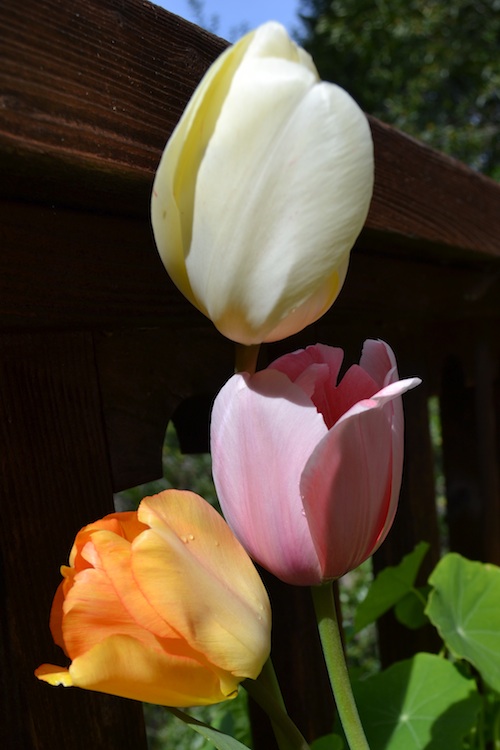
Salmon Impression

We chose Salmon Impression for its wonderful pastel color, and it didn’t disappoint. This variety yielded beautiful large flowers on strong, tall (20-24″) stems. I especially enjoyed the subtle green coloring on each petal.

Ivory Floradale

Another gorgeous flower (and another Darwin Hybrid type), the Ivory Floradale came in colors ranging from yellow to cream. They also produced a large and interesting flower on a sturdy 20-22″ stem.

DAYDream

A favorite from years past, the Daydream continued to delight again and was a great compliment and accent to the other colors and varieties. Another sturdy flower on a 20-24″ stem, this Darwin Hybrid produced a bright, apricot color and dark centers that were revealed when the petals opened in the sun.

china town

Our last flower, China Town, looked like a lot of fun, with its frilly, multi-colored petals, but, alas, the bulbs went into the ground and failed to grow. Luckily they were in a separate container, so that our bright display bloomed in a happy group.

As always, we treasured our tulips while they were here. Until next year!

Photos by Susan Sachs Lipman

More Tulipmania from Slow Family:

Tulipmania 2010, Part One (Lots of tulip photos)
Tulipmania 2010, Part Two (More tulip photos)
Tulipmania: One Bubble I can Really Get Behind
Tulips are in the Ground

Related Posts Plugin for WordPress, Blogger...